
Why a room with no window goes stale
An opening rooflight for ventilation does a job that no wall window can do in an internal room: it lets air leave from the highest point of the house. Rooms without an outside wall of their own hold on to steam, cooking smells and warm air, because nothing moves it. A rooflight that opens, which many homeowners call an opening skylight, supplies the missing exit.
Air moves through a house for a simple reason. Warm, damp air is lighter than the cool air around it, so it rises, and it keeps rising until it meets a ceiling. If there is an opening at that ceiling, the air leaves and cooler air is drawn in lower down to replace it. An opening in the roof works on that principle at its strongest, because it sits at the highest point the air can reach.
That is the whole case for opening glass in a room without a window. The sections below take three rooms that can have no window to open, then look at where the unit goes on the roof, which type suits a pitched or a flat roof, and how to use it day to day.
The internal bathroom
An internal bathroom has little or no outside wall of its own: it sits in the middle of the plan, with a bedroom or a landing on every side. Bathrooms like this are typical of newer houses and conversions. After a shower the room fills with steam, and with no window to open the moisture has to find its own way out.
Approved Document F calls for extract ventilation in a bathroom, so a bathroom with no outside wall has an extract fan, and that fan stays in place. An opening rooflight works with it. The fan clears the steam quietly while the shower runs, and the open glass lets a larger volume of damp air out afterwards and brings fresh air in. If the ceiling beneath a roof is within reach, a bathroom is also the room where a sun tunnel is often considered, but a sun tunnel brings daylight only and does not open, and an opening roof window or rooflight is the choice when the aim is air.
Where the glass goes over a bathroom
The best position is over the part of the room where steam collects, which is usually the shower end rather than the middle of the floor. A unit directly over the shower needs a specification that takes constant moisture, and the electrician or fitter keeps any control well out of the wet zones. Over the basin end, the glass catches the warm air that drifts up and across the ceiling.
If the bathroom is in a loft conversion, the sloping ceiling means the roof window is often within arm's reach, and a manual handle is enough.
The landing and the stairwell
A staircase is a tall chimney of air inside the house. Warm air from the downstairs rooms rises up it, collects under the roof and sits on the landing, which is why the top of the house is stuffy in summer. An opening rooflight over the stairwell breaks that pattern, because the hottest air has a way out. That also draws cooler air in at ground level, through a front door left on the latch or a window in one of the lower rooms.
On a landing this works for any season. In winter the glass is shut. In summer, open on a warm night, it empties the heat out of the upstairs rooms without anybody having to climb the stairs to do it. The stairwell is also the place where the glass is hardest to reach by hand, so an electric or solar unit, worked from a control near the bottom of the stairs, suits a stairwell. The three types are compared under electric, solar or manual rooflights.
For a stairwell the daylight matters as much as the air. A landing in the middle of a terrace is among the gloomier parts of the house, and a single rooflight can handle both jobs. The daylight side is treated in detail under roof window over stairs and landing.
On a warm night, an open rooflight above the stairs lets the hottest air in the house leave through the roof, and draws cooler air in below.
The middle room of a terrace
In a through-terrace, the middle room often has little or no outside wall of its own. It has party walls on both sides, a front room on one side and a back room on the other, and it is lit and aired only through the doors that join it to them. A cooking or bedroom smell has nowhere to go but into the next room.
The same applies to the rear of a back-to-back, which shares its back wall with the house behind, and to a box room tucked under the eaves. Where there is roof above, an opening unit gives these rooms an exit for air, and the daylight comes with it.
Two openings make a draught
For air to move through the middle room, it needs a way in as well as a way out. A rooflight on its own will still lift the warm air, and it will draw replacement air from the doors that open into neighbouring rooms. If those doors are shut, the flow is weak, so the usual advice is to leave a door ajar on the side facing a window.
When the middle room is downstairs
A middle room on the ground floor has a bedroom or loft above it, and the roof is a long way off. A rooflight cannot serve that room directly, and a sun tunnel or a lantern in an extension roof may be a better route. We look at what is above the room first, and say if the roof is not the right answer.
Where on the roof the unit should go
Position matters as much as the choice of unit. Three things guide where we put the glass.
- Height. The glass should sit as high on the slope as the room allows, because warm air collects at the top and an opening low down lets some of it stay.
- The wet end of the room. Over a bathroom this is the shower; over a kitchen it is the hob; over a landing it is the head of the stairs.
- The route in. There has to be somewhere for fresh air to come from, such as a window in a nearby room or a door left open.
Sloping roofs and flat roofs
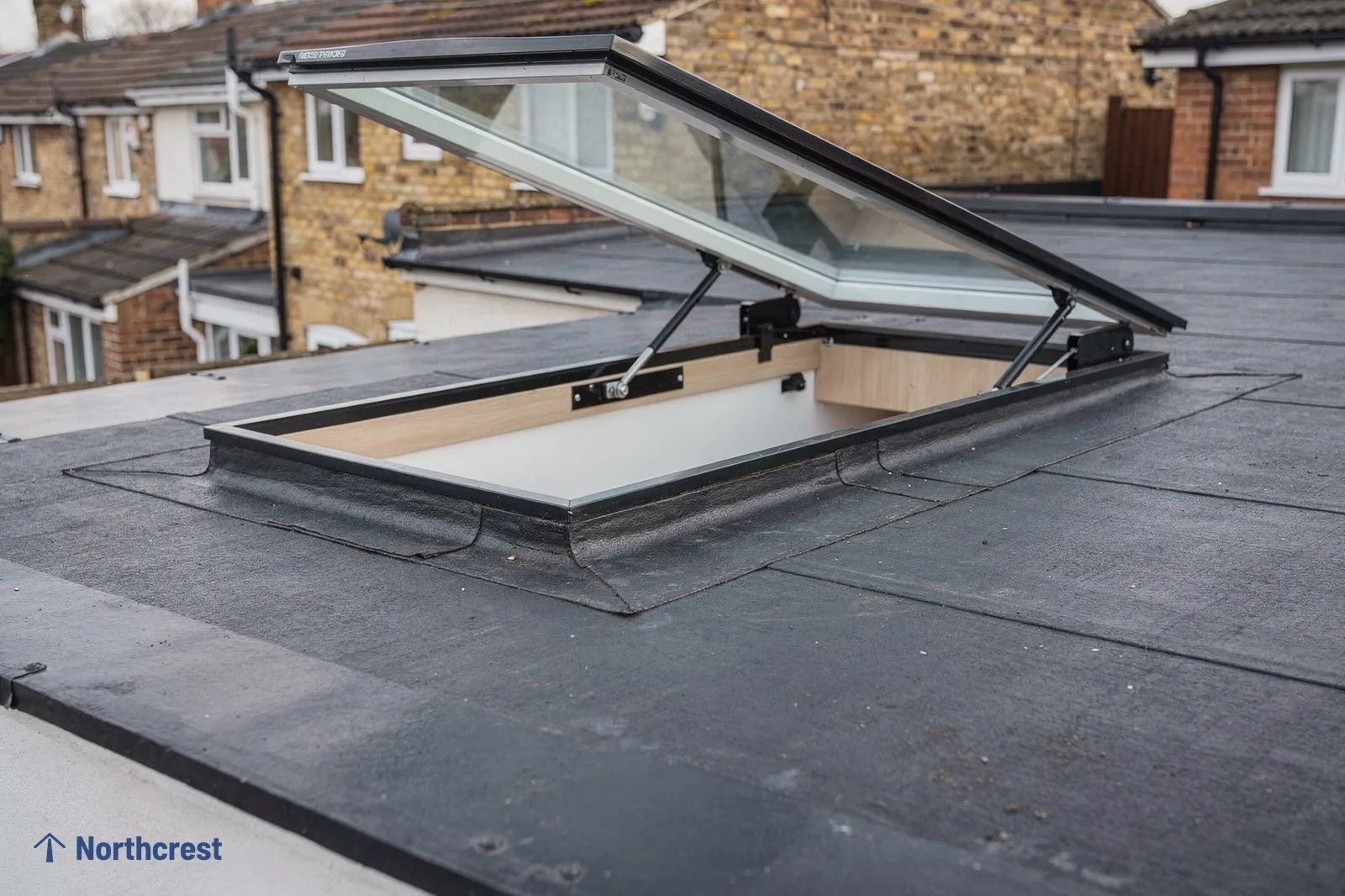
On a pitched roof the opening has to sit between rafters, which sets its width, and the flashing has to suit the covering. Slate, concrete tile and clay tile each take a different flashing, and the maker's kit is matched to the roof. On a flat roof the opening sits on a kerb, and a hinged rooflight lifts on arms. Sizes and kerb heights follow from the make, and the maker gives the measurements its sizes refer to.
Kitchens at the back of a terrace
A kitchen built out at the back of a terrace has the same pattern in a different room. Cooking steam and smells rise to the extension ceiling and settle there. A hinged rooflight over the hob end of the room lets them leave, and where the extension has a back door or a window to bring the replacement air in, it is one of the easier rooms to ventilate from the roof.
Away from the neighbours
An open rooflight lets sound as well as air through. If the next-door garden or bedroom is close, it is worth setting the unit on the slope that faces away from it.
Choosing a pitched or flat unit that opens
The roof above the room shapes the choice more than anything else.
Roof windows on a pitched roof
A roof window opens in one of two ways. A centre-pivot window swings on a hinge line across its middle, which suits a room with furniture beneath it. A top-hung window opens outwards from its upper edge and keeps the space below clear, which helps over a landing where people walk. Both can be fitted with a motor, and a roof window of either type can sit in a bathroom or on a stair. Our roof window installation page covers the types in full.
Hinged rooflights on a flat roof
A flat rooflight that opens suits a kitchen extension, a bathroom below a flat roof or a back room built on to a terrace. It lifts on one or two arms, and a mains or solar motor can drive them. Our page on flat roof rooflights goes through the options.
Conservation rooflights that open
In a conservation area, an opening unit can still be a slim black-framed conservation rooflight. Whether yours opens is covered in our answer on whether conservation rooflights open.
Using the glass day to day
For a bathroom, open the glass after a shower and leave it ajar until the surfaces have lost their sheen. For a landing, open it on the warmest evenings and close it before the house cools. The fresh air that comes in should always have somewhere to arrive from, so keep one lower window or door ajar.
A rain sensor, where the model carries one, closes an electric unit if a shower starts while you are out. Its behaviour is described in how a rain sensor shuts the glass. A blind on the glass cuts glare and summer sun, and it works alongside an open sash.
Opening and closing the unit soon becomes a habit, like pulling a bathroom door shut. Where the glass is out of reach, a switch by the door or a remote kept in the room makes the habit easier to keep, and a unit that is easy to open is the one that actually gets opened.
Condensation on the inside of a rooflight in a damp room is usually a sign that the room needs more airing. Condensation trapped between the panes is a different matter, because the sealed unit has lost its seal, so the glass must be replaced; see why rooflight glass mists.
The opening itself, and who handles what
We notify Building Control of a new roof opening, since it alters the structure. On a house, a rooflight normally falls within permitted development, subject to the limits set out in what planning and Building Regulations say about skylights. Conservation areas and listed buildings need a check first.
Once the unit is in, the reveal inside is plastered and finished to the quote, which is fixed in writing. Our guarantee on the workmanship runs for 10 years. To talk through a stuffy room in your own house, send a WhatsApp message to 07880 284133 and ask for a survey.