The answer
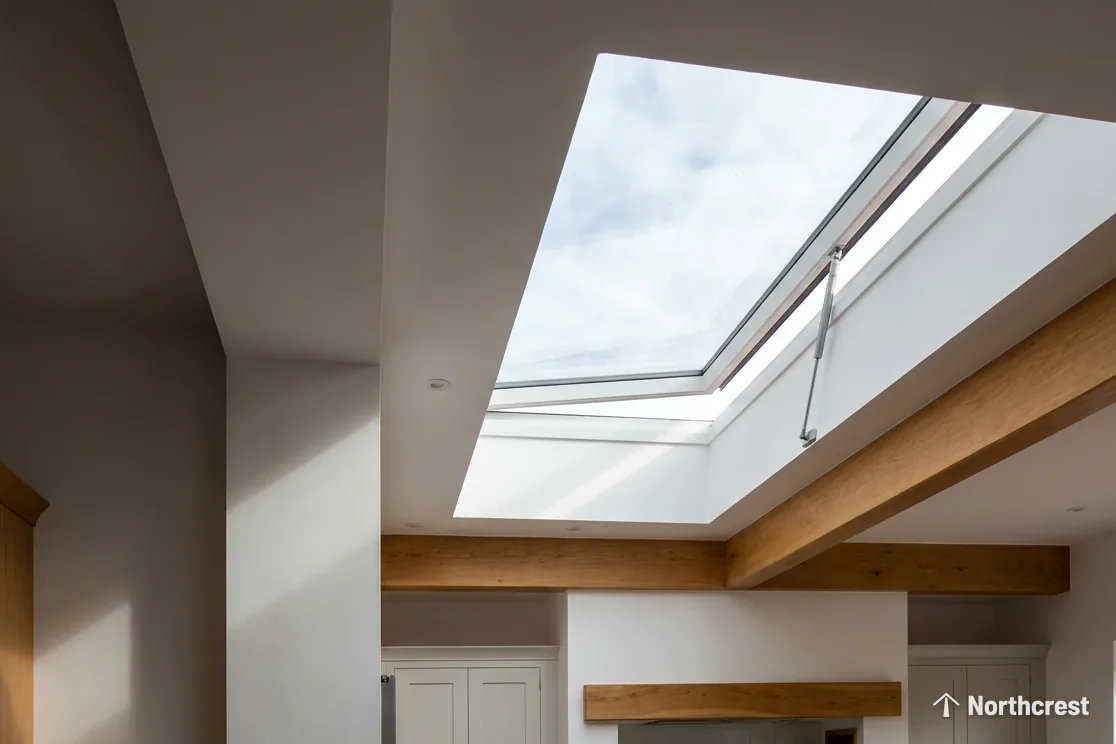
A skylight rain sensor is a small plate on the outside of an electric unit that notices moisture and signals the motor to close the glass. Many electric models carry one, though not every model does. The sensor needs power to act, and the wall switch or remote still opens and closes the rooflight whenever you choose.
How the sensor notices rain
On an electric rooflight that has one, the rain sensor sits on the outside, usually on the frame or the glass edge, where raindrops will reach it. When moisture lands on the plate, it sends a signal to the motor, and the motor draws the sash shut until the seal is tight. The sensor is part of the unit as supplied, and it is wired or paired to the same motor that the switch and the remote drive.
Here is how that helps. You open the glass on a warm morning to air a bathroom or a stairwell, then go out. If a shower arrives while you are away, the rooflight closes without anybody touching it. For that reason a sensor is worth choosing on any unit that is likely to be left open, whether it is over a stair, a shower room or a kitchen extension.
Not every electric model comes with a sensor. It is a specification choice, made when the unit is ordered, and the other choices are laid out in electric, solar or manual rooflights compared.
Keeping the plate clear
The plate only works while rain can reach it. Leaf litter from a nearby tree, moss on a shaded slope or bird mess can blanket it, and a wipe with a soft cloth and clean water, taken from a safe position, keeps it clear. Do not climb onto a roof to do it. If the plate cannot be reached safely from a window or a ladder, mention it when the unit is chosen, so the position of the roof slope and the access can be weighed.
How quickly the glass closes
The glass closes as fast as its motor can move it. There is a short delay while the sensor registers the moisture, and then the sash travels from wherever it was to fully shut. A unit open only a little closes in less time than one open to its full extent, and a large sash on a long chain takes longer than a small one on a short stroke. Each maker gives the travel time for the model, and it is worth asking for it if a fast close matters to you.
A sensor reacts to rain landing on it. Because of that, the sash can be open for a moment while the first drops fall, and a few drops can reach the reveal before the seal is tight. Over a bathroom floor or a stair carpet those drops matter, so it makes sense to keep the glass closed when you go out for the day and to treat the sensor as a safety net.
What happens in a power cut
A mains unit needs power to move, so in a power cut it may not respond to the sensor, the switch or the remote until the supply comes back. What happens depends on the model. Some can be wound shut by hand with a tool, and some carry a battery that keeps the motor working for a while, but others have neither. The maker's data for the model states which applies, and it is worth reading before you buy a unit for a spot you cannot reach.
A solar model runs from its own battery, so it is not tied to the mains. It has its own limit, because a flat battery will not close the glass either. For a rooflight over a stairwell, where nobody can climb up to close it, we talk through the failure behaviour of the model before you decide.
The sensible habit, with any electric unit, is to close the glass with the switch or remote before a long absence. Then the sensor and the motor are only the back-up.
Where the wall switch or remote goes
A wall switch is wired in beside the door, or by the stairs for a landing unit. It needs to sit where you can find it with a hand full of washing or a tray, and where nobody can lean on it by accident. A handheld remote can live in a drawer or on a hook in the room, and a remote suits a loft room where you want to open the glass from bed.
In a bathroom, the wiring rules limit where switches may be placed near a bath or shower, so the switch goes outside those zones and the electrician puts it in. A remote avoids the question, because there is nothing fixed to the wall at all.
The cable for a mains switch has to be routed from the supply to the switch and the motor. That is easiest while the ceiling is open, and it is why the cost of the electrical connection varies from room to room; see how much an electric rooflight costs.
What a rain sensor leaves to you
On its own, a rain sensor closes a rooflight and does not open it again, so if you want fresh air after the shower has passed, the switch or the remote does that. Airing a damp room is a separate matter, which opening rooflights for ventilation covers in full.
A closed rooflight keeps water out through its kerb, flashing and seals, which is a separate subject taken up in whether an opening rooflight leaks.
We fit electric rooflights with and without sensors, and we go over the choice of controls when we visit. Our guarantee covers the workmanship for 10 years. To arrange a free survey, send us a WhatsApp message on 07880 284133.