Misted and failed rooflight replacement in Leeds
Misted rooflight replacement in Leeds starts by working out whether the glass or the whole unit has failed, then fitting a new sealed unit or a new rooflight to suit the roof.
- Free survey and fixed written quote
- Planning checked before we order
- Building Control notification handled
- 10-year workmanship guarantee
Misted and failed rooflights, Leeds
Eight questions on replacing a misted or failed rooflight
How to tell a failed unit from condensation, what gets replaced, what the work depends on, and how the room and roof are left.
Is the mist between the panes, and does it mean my rooflight has failed?
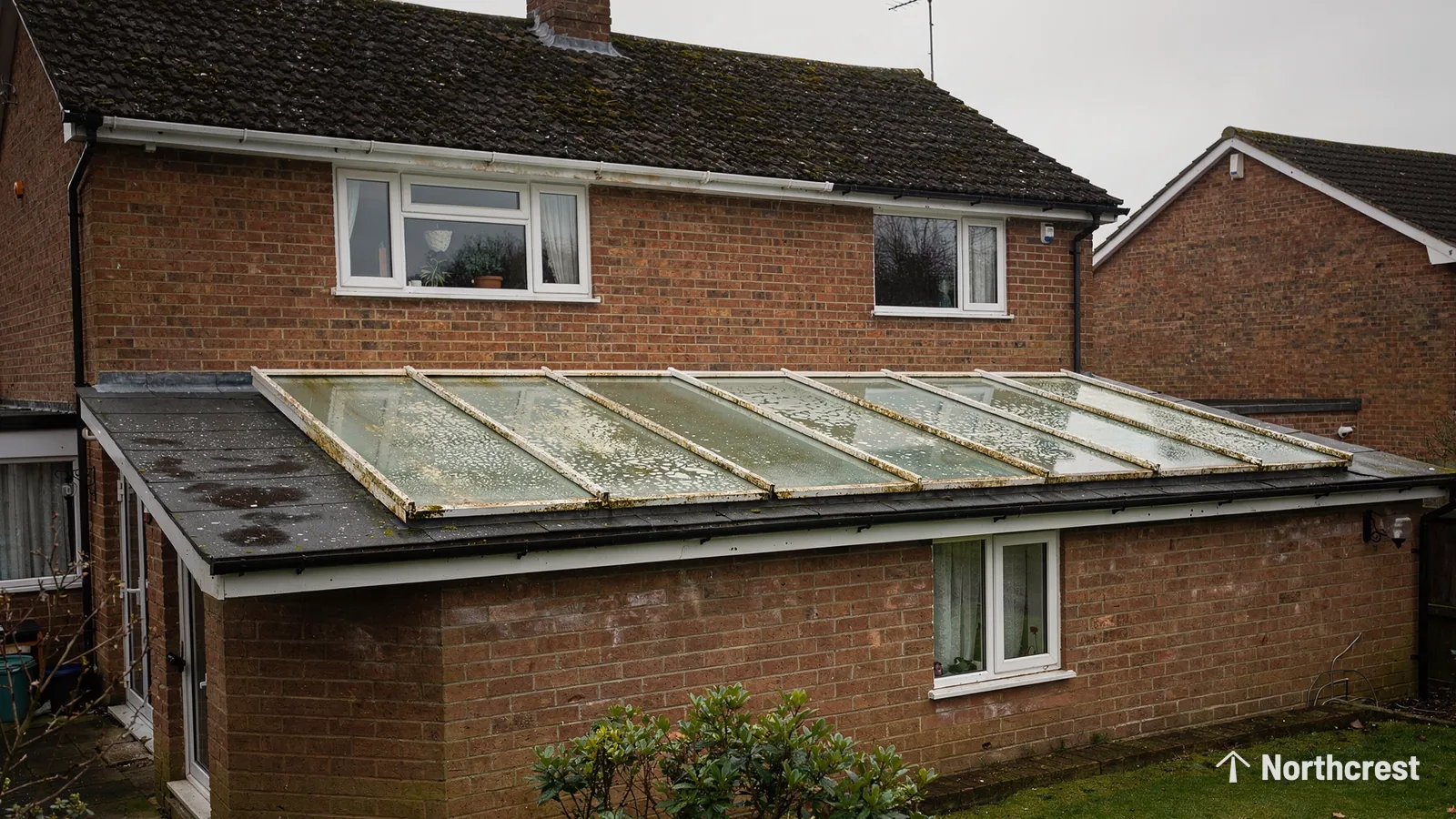
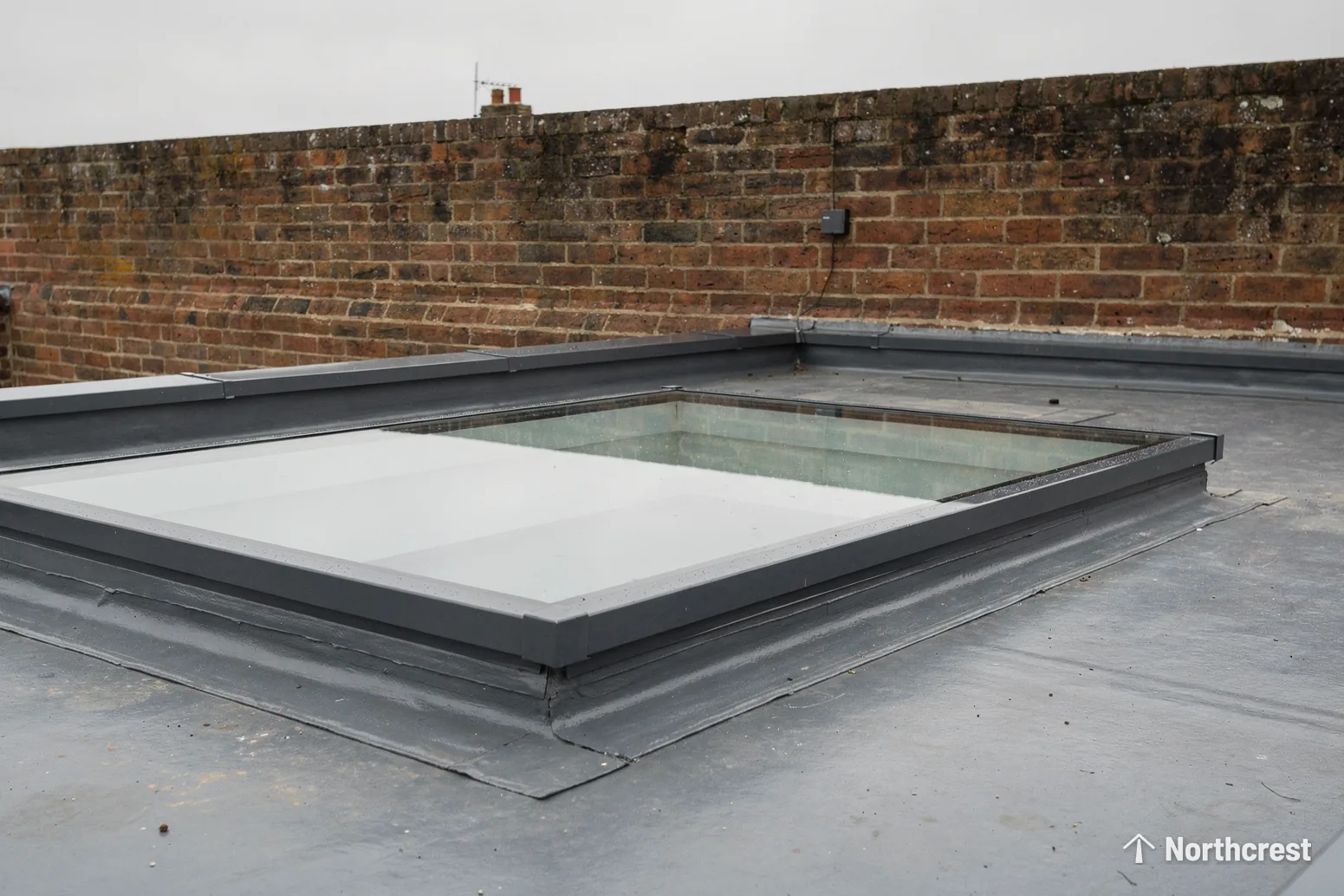
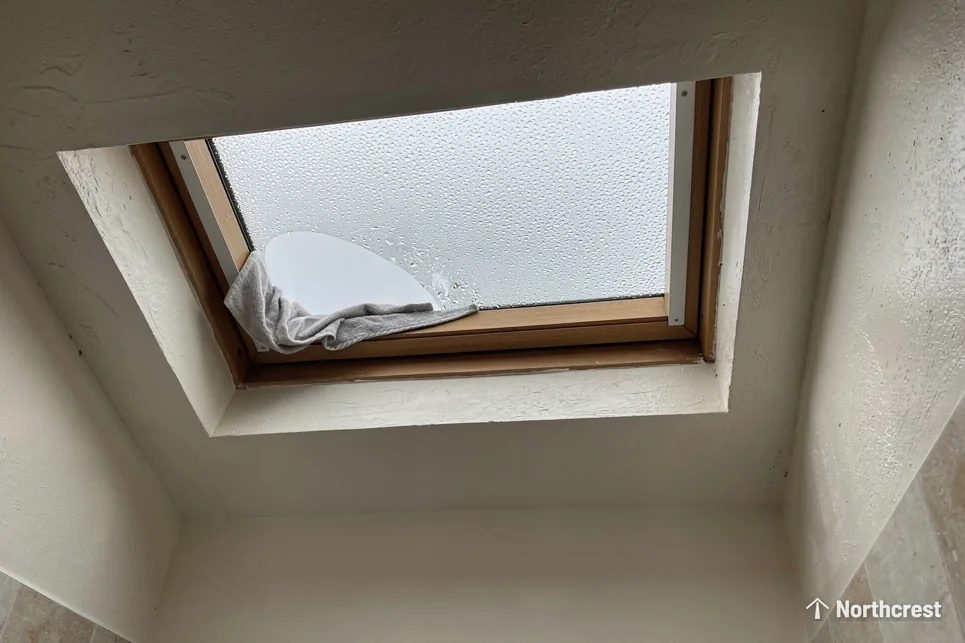
Misted rooflight replacement begins with finding out where the water sits. The glass in a rooflight is a sealed unit: two or three sheets held apart by a spacer, with a dry gap between them. When the edge seal lets damp air in, a haze or a ring of droplets forms inside that gap, out of reach from the room and from the roof. Wiping the inside face or washing the outside face changes nothing, because the water is on neither surface.
A skylight can look cloudy for three different reasons, and only one is a failed unit. Drops on the room side come from damp air meeting a cold pane. Grime or algae on the outer face looks like a cloud from underneath, and a wash clears it. Mist between the sheets shows the unit's edge seal has failed, with moisture now sealed inside, and that needs a new unit. The mechanism is followed step by step under why rooflight glass mists between the panes.
Failure signs that call for replacement
- A milky haze or droplets between the sheets, thicker on a cold morning and thinner by the afternoon.
- White tide marks left inside the gap once the water has dried back.
- A frame that has gone soft, split or open at the joints where the glass meets it.
- A stain on the ceiling reveal or a damp mark round the kerb, which can mean a leak at the flashing as well as a tired unit.
- A room under the rooflight that feels colder than it used to.
A leak is a separate fault
The water inside a misted unit is moisture from the air, so misting on its own is not a leak. A leak shows as a drip, a stain or swollen plaster. The two can turn up together, because a seal that has stayed wet and a flashing that has lifted are both signs of an installation that has had its day. At survey we look at the glass, the frame, the kerb and the covering round them, so that the replacement matches what has actually failed.
- Sealed unit: two panes with a warm-edge spacer
- Insulated kerb lifting the unit clear of the roof
Condensation on a roof window is not the same thing
Drops on the room side of a roof window mean warm, damp air is meeting a cold surface. Cooking, bathing and drying washing load the air with moisture, and a rooflight is often the coldest surface in the room. Better ventilation helps, and so does a newer unit with warm-edge spacers and a thermally broken frame, which keeps the inner pane warmer. Our energy efficient rooflights page covers the glazing that does it.
Heard at the door
Asked before the survey
Can you replace just the glass in a skylight, or does the whole rooflight come out?
The short answer
Where the frame is sound, a new sealed glass unit can go into it. Where the frame, seals or kerb have given up too, the whole rooflight is replaced. We work out which at the survey and the quote gives the unit and its size.
Replacing the glazed unit on its own is possible when everything round it is in good order. The sealed unit can fail while the frame is still good, and in a sound frame it can be lifted out and a new one, made to the same size, set in its place. It suits a rooflight whose frame is straight, whose gaskets still grip and whose kerb and flashing are watertight.
The whole rooflight comes out when the frame has aged along with the glass. A timber frame that has swollen and split, an aluminium frame with perished gaskets or a kerb that has moved will not hold a new unit for long, and glass set into a worn frame carries the old weakness into the new unit. A new rooflight is the better route then, and it is also the point at which the size, type and position of the opening can change.

Replacement types and your options
There are three routes. The first is a new glazed unit set into the frame you have. The second is a new rooflight on the existing kerb or in the existing opening, which suits a worn frame on a roof that is otherwise sound. The third is a new rooflight on a new kerb, for a roof where the upstand itself has failed. Whichever applies, you receive one unit at one size in writing, and we explain why that route fits your roof when we have been up and looked.
Sizes and measuring the new unit
A replacement sealed unit is made to the measured size of the old one, so we measure the glass and the rebate it sits in, which is the groove that holds the edge, as well as the outside of the frame. On a flat rooflight the dimension that matters is the kerb. A maker may take its stated size from the inside face of the upstand or from the outside, and a unit ordered to the wrong face arrives wrong. On a VELUX roof window the code on the label, such as MK04, reads width from its first letter and height from the digits after it, and we use it as a starting point that we then check against the opening.
If the label has gone or the maker has withdrawn that size, we measure the opening and look for the closest current size. Our answer on replacing an old roof window like-for-like sets out what happens then.
What failed and what is replaced
| What has failed | What is replaced | What stays |
|---|---|---|
| Sealed unit only | New sealed glass unit | Frame, kerb and flashing |
| Sealed unit and gaskets | New unit with fresh seals | Frame and kerb |
| Frame worn or split | Whole rooflight | Kerb, if it is sound |
| Kerb or upstand failing | Rooflight and kerb | Roof covering beyond the work |
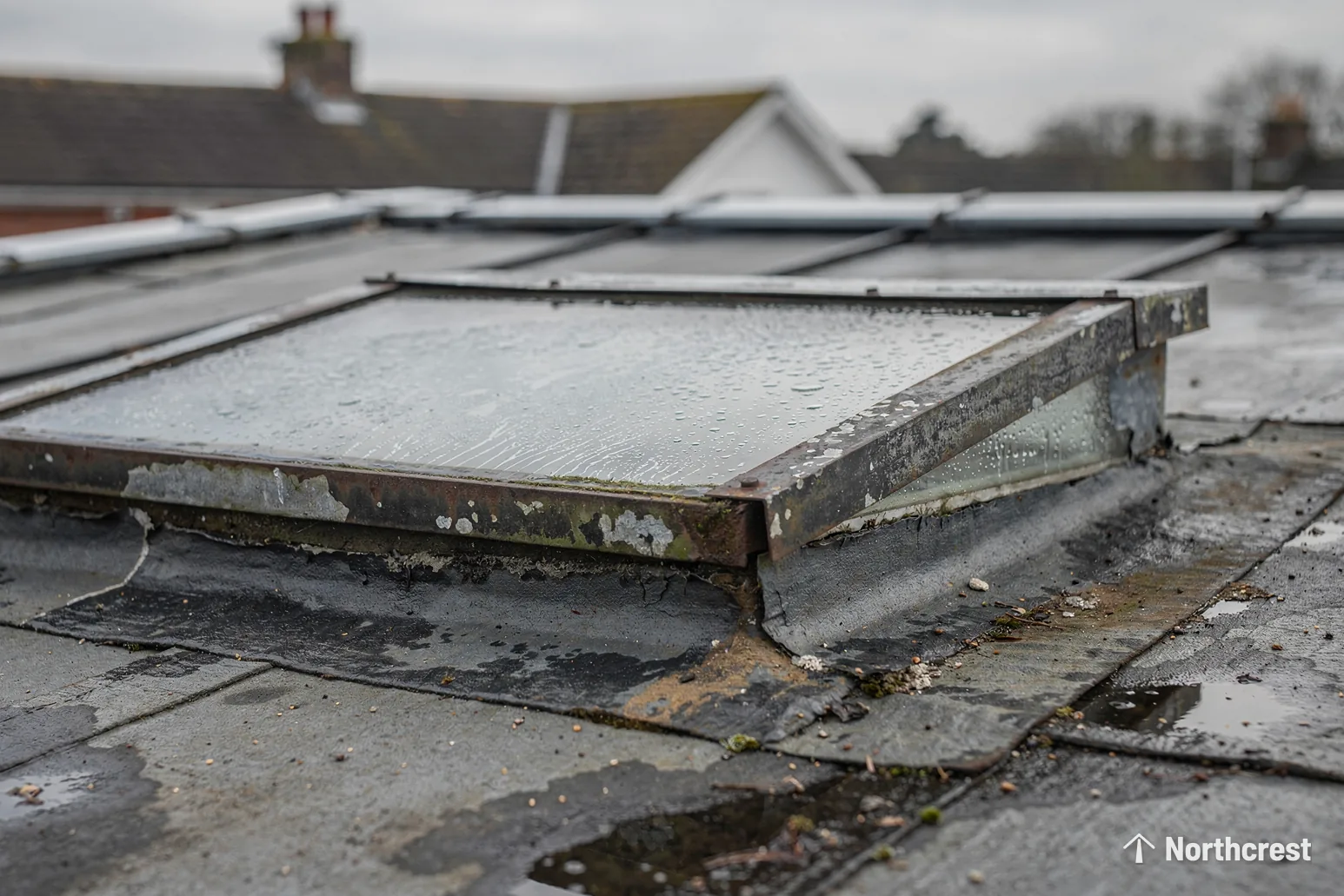
| Old glazed lean-to panels | New glazed panels or a rooflight | Supporting structure, if sound |
What does the cost of replacing a rooflight depend on?
People ask how much a replacement rooflight costs, and the answer starts with what has failed. New glass in a sound frame is a smaller job than a new rooflight, and a new rooflight on a kerb that can stay is smaller than one that needs a new kerb. We give no figure until we have seen the roof, and after the survey the figure is fixed in writing and tied to one unit at one stated size.
Three things move it more than the rest. Size comes first, since a bigger unit means larger glass, a heavier lift and more weathering round the edge. Access is second: a rooflight reached from a landing and a ladder is quicker to handle than one that needs scaffold at the eaves or a lift over a yard wall. The third is the roof round the opening, because a felt upstand that has to be rebuilt adds work that glass alone does not.
Cost factors that move the figure
Glazing choice moves the figure too. A made-to-measure unit for an odd opening costs more than a stock size, and a frame in a special colour can cost more than white. Our costs page explains how a quote is put together, what a skylight costs to replace looks at the whole unit, and the answer on how much it costs to replace the glass in a skylight covers the glass alone.
Is there a cheaper make than VELUX?
Where the rooflight is a VELUX roof window we can supply a VELUX replacement, and we also fit other makes. A different make can suit an opening where it offers a size that fits closely. Which one costs less depends on the size and the specification, and the unit we recommend goes into the written quote at its stated size.
Should a failed rooflight go back the same size, or is this the moment to light the room properly?
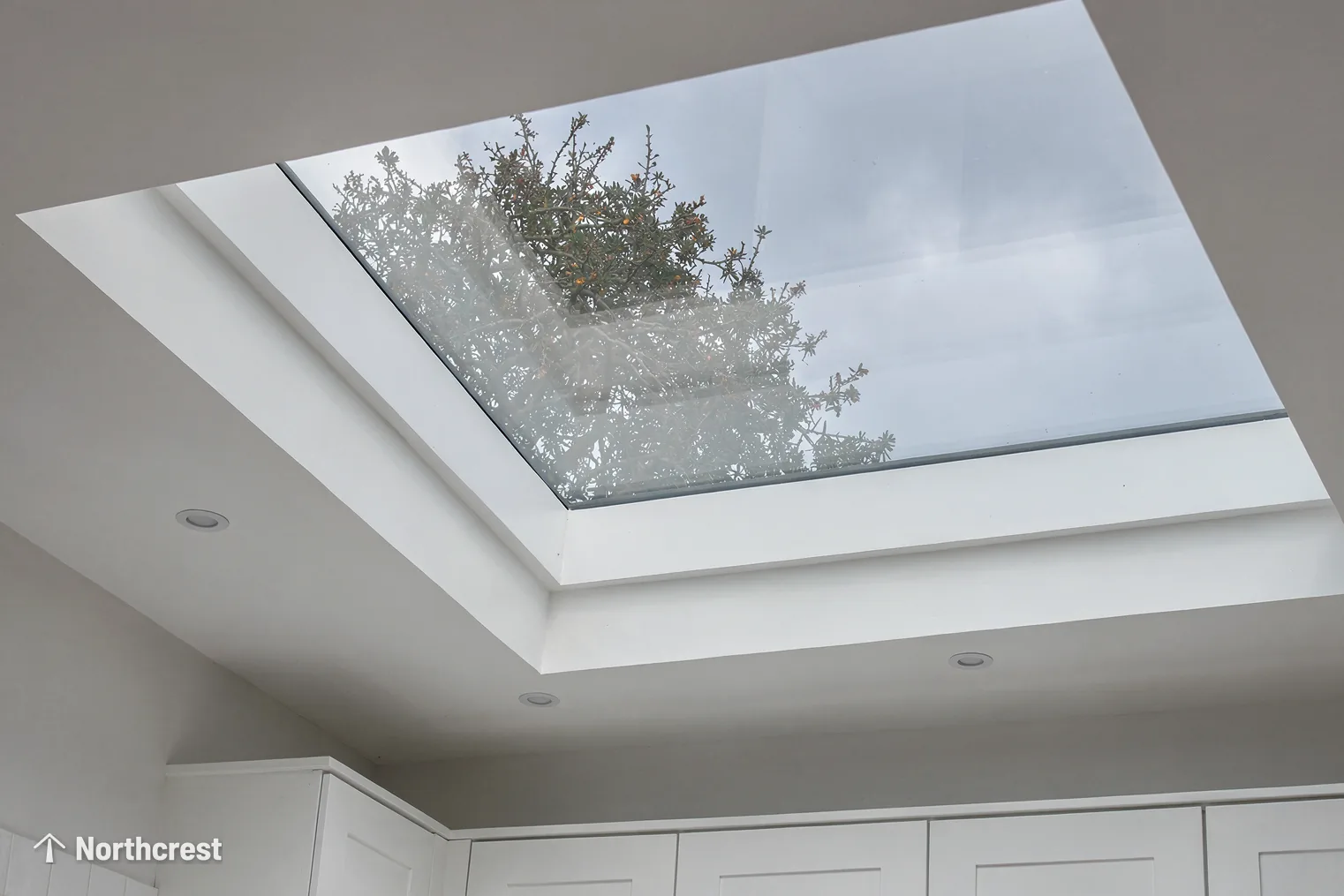
A misted rooflight is a prompt to look at the room under it. If that room is bright and the rooflight was a bonus, a matching unit in the same place is sensible, and it keeps the work to the unit and its flashing. If the room under it was always gloomy, a failed unit is the easiest moment you will get to change the opening.
The roof is already being opened up. A larger opening, a move along the roof to sit over the part of the floor that needs it, or a swap from a fixed unit to one that opens each use the same access, the same weathering and the same making good as a like-for-like swap, with some extra work on the roof structure. Each choice, and what it changes in the roof and the room, is worked through under swapping a failed rooflight for a bigger one.
Why some rooms depend on the roof for their daylight
On a landing, in the middle of a terrace or at the inner end of a long extension, a room has almost no outer wall of its own to put a window in. Daylight can only arrive from above, so the rooflight carries the whole room. That is why we begin with the room and work back to the roof, as our darkest room first page explains.
Light, space and value from the new unit
A bigger or better placed rooflight brings more natural light to the floor and the walls, which can free up a corner that nobody used. A unit that opens adds ventilation, and an electric one helps where the ceiling is out of reach. Whether a brighter room adds to a home's value is a question for an estate agent, and we make no claim about it.
- Cut rafter ends carried on trimmers
- Rafters either side doubled up
- The new opening between them
Changing the type of unit
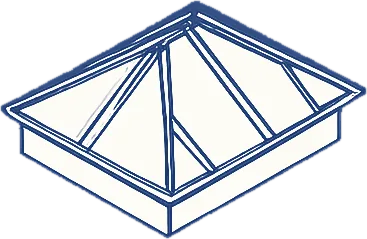
A failed flat rooflight can be replaced by a different flat rooflight, or, where the room below is deep, by something larger; our flat roof rooflights page sets out the options. A failed roof window in a pitched roof can come back as a roof window, and the roof window installation page covers the choices there, centre-pivot and top-hung among them. A larger opening alters the roof structure, which brings a trimmer, a notification and a check on planning, and the regulations chapter below covers those.
Heard at the door
What we look at from inside the room
What glass and frame should the new rooflight have, and how much heat will it keep in?
The short answer
A new unit can be double or triple glazed, with a low-emissivity coating, a warm-edge spacer and a gas fill, in a frame built to limit heat loss. Part L sets the limit that a replacement rooflight or roof window must reach.
A unit that has let in damp air may also have lost some of its gas fill, so a failed rooflight can lose more heat than it did when new. The replacement is a chance to bring it up to today's standard, and in an existing home that standard is set by Part L of the Building Regulations. Approved Document L Volume 1, Table 4.2 gives a replacement rooflight, a roof lantern included, a whole-unit U-value of 2.2 W/m²K, and gives a roof window 1.4 W/m²K or Window Energy Rating band B. The smaller the figure, the slower the heat escapes.
Energy efficient glazing and insulation
Three choices in the sealed unit do most of the work. The first is the number of sheets: triple glazing adds a second gap and holds more heat than double, at the cost of weight and thickness. The second is a low-emissivity coating on one inner face, which sends heat back into the room. The third is a warm-edge spacer, which stops the rim of the glass becoming the coldest strip in the unit and, with it, the place where condensation starts. Gas fills of argon or krypton slow heat transfer across the gap. A solar control coating can be added for a south-facing roof that heats a room in summer.
The kerb on a flat roof should be insulated and the reveal below lined, so no cold band forms round the opening.
- Roof window in a slate or tile pitch
- Rooflight on a kerb on a flat roof
Frame materials and the finishes on offer
Timber frames are warm to the touch and can be painted or lacquered to suit a room. Aluminium is stronger, so its frames can be slimmer, and a good one carries a thermal break so the inner face does not run cold. uPVC frames cost less and ask for little upkeep, and they suit a modest rooflight over a short room. Powder-coated aluminium comes in many colours, and on a traditional slate or stone roof a slim, dark frame sitting low to the slope suits the covering, which our conservation rooflights page describes.
Safety glass, toughened panes and walk-on units
Glass overhead is chosen with breakage in mind. Roof glazing units can use a toughened outer sheet, and some makers add a laminated inner sheet that holds together if it cracks, which suits a unit above a kitchen or a stair. A walk-on rooflight is a separate product: a flat panel its maker rates for foot traffic, set level with a terrace or floor. An ordinary rooflight is not made to stand on, and nobody should kneel on the glass to clean it. As for security, a replacement frame with a fresh seal and proper fixings is no easier to force than the one it replaces.
Limits for a replacement in an existing home
| Unit | Limit | Example |
|---|---|---|
| Flat rooflight, lantern included | U-value 2.2 W/m²K | Glass rooflight on a flat roof |
| Roof window | U-value 1.4 W/m²K, or band B | Window in a pitched roof |
Short FAQs on the glass itself
Will the new glass be clearer than the old? A new unit has none of the haze, and a self-cleaning outer coating, where a maker offers one, helps rain carry dirt away. Will it be louder in rain? Glass is louder than a solid roof, and thicker or laminated glass softens the sound.
How does the roof under the rooflight change the replacement?
A rooflight keeps water out only as well as its joint with the roof covering allows, so the roof sets how much of the job is the unit and how much is the weathering round it. The two kinds of roof need different work, and a misted unit on each starts with a different question.
Flat, pitched, slate and tile roofs
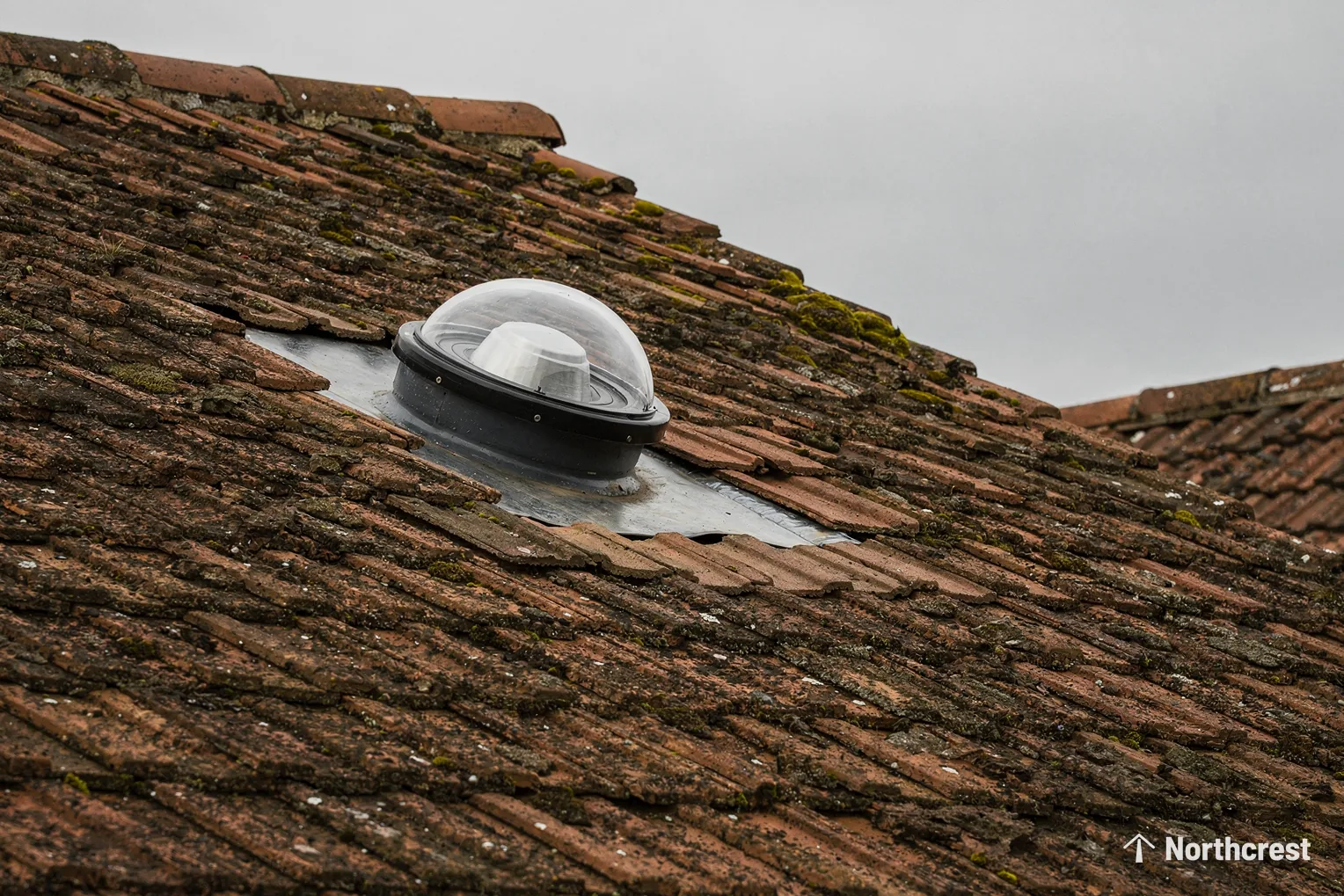
A flat rooflight sits on a kerb, an upstand of timber or a made-up unit that lifts the glass clear of standing water. The roof covering is turned up the sides of the kerb, so replacing the unit means checking that the covering is still sound at the edges. A pitched roof is different: a roof window sits within the slope, and a flashing kit overlaps the slates or tiles round it so that water runs over the frame and away from the opening. Slate covers many an older Leeds roof and concrete tile the later ones, and each takes a flashing of its own.
Heard at the door
Asked before the survey
Flat roof coverings and their upstands
- Felt is built up in layers, and new felt is dressed up the kerb and lapped over the old roof.
- EPDM rubber is a single sheet, bonded to the kerb and joined to the existing sheet with the maker's primer and tape.
- GRP fibreglass is laid wet over boards, with the upstand laminated into the roof and a topcoat over it.
If the flat roof is nearly spent, it makes sense to plan its re-covering and the new rooflight together, since weathering the same kerb twice is wasteful.
Polycarbonate sheets and glazed lean-tos
Some older roofs, lean-to roofs in particular, are glazed in polycarbonate sheet instead of glass. Polycarbonate does not mist the way a sealed glass unit does: it yellows, scratches and clouds with age. Where one of those roofs is due for replacement, a glass rooflight can take its place, provided the supporting structure is sound and the new unit meets the Part L limit.
On a shallow pitch, such as a lean-to over a back kitchen, standing water at the lower edge of the glass can make a seal give up sooner. A replacement can sit on a raised kerb so that rain clears the glass, and what wears, and in which order, is covered in how long glass skylights last.
Does replacing a rooflight need planning permission or Building Control?
Permitted development can cover a rooflight on a house when the unit stands out no further than 150mm from the slope, sits no higher than the highest point of the roof and meets the other conditions. The planning guide lists the full conditions. A like-for-like swap in the same opening seldom changes any of that, but a larger unit or a new position might, so we check before we order.
Conservation areas, listed buildings and flats
Some conservation areas sit under an Article 4 direction that withdraws those rights, so ask the council first. A listed house is a separate case: new rooflight work there needs listed building consent, whatever permitted development reads. In a flat, roof alterations fall outside permitted development, so you will usually need permission; the council will confirm. For homes in the city that is Leeds City Council, and for towns further out it is the council that covers the town.
Building Regulations on a replacement
A replacement rooflight or roof window counts as notifiable building work under Part L. We notify Building Control, through the local authority or through a registered building control approver. A new opening, or an existing one made bigger, alters the roof structure and falls under Approved Document A too, and that is notified as well.
These rules are why an old rooflight seldom goes back exactly as it was. The standard in force on the day of fitting applies to the new unit, and it can be stricter than the one the original met.
What happens on the day the old unit comes out, and how is the room left?
The floor and furniture under the opening are sheeted before anything is lifted, because taking out an old unit makes dust. If the weather turns while the roof is open, the opening is covered so the room stays dry until the new unit is in.
How the installation process runs, and how long it lasts
- The old unit comes out, whole or in parts, depending on its size and how it was fixed.
- The kerb or the frame is checked for squareness and soundness, and the flashing or covering is dressed back to a good edge.
- The new unit is set, bedded and fixed through the frame, then sealed against the weather.
- The covering or the flashing is finished round it.
- Inside, the reveal is made good: lined where it needs it, plastered and finished as quoted.
The length of the job follows the unit, the roof and the path up to it. We agree the plan for the day with you, including where the old unit goes and where the new one is brought in.
Heard at the door
Before the day itself
What the room looks like afterwards
Looking up, you see a clean reveal, a clear sealed unit and a frame in the finish that was quoted. There is no haze between the panes and no tide marks left in the gap. Afterwards a soft cloth and clean water are all the unit needs, and nobody should stand or kneel on the glass.
Areas covered around Leeds
We replace rooflights and skylights for homes in Leeds and in the towns around it, as far out as 30 road miles, and we take on small commercial jobs on the same work. Our areas page lists the towns. If you are not sure the time has come, when to replace a skylight helps with that decision.
What you can check for yourself
Each quote names the room, the unit chosen for it and its size, so you can test our choice against your own house. The free survey comes first and the price that follows is fixed. Our guarantee explains what our workmanship guarantee includes. The quote form is the place to start.
Small questions about swapping a misted rooflight
Can a roofer fit a skylight?
Roofers can fit skylights, and the job is half roofing and half glazing, since the opening, the weathering and the glass must all be right together. Installing and replacing skylights and rooflights is our own trade, so the kerb or flashing and the glazed unit are planned as one job.
Can the new rooflight open if the old one was fixed?
A fixed unit can be swapped for one that opens, which adds ventilation to a landing, a bathroom or a kitchen. An electric unit can close itself when its rain sensor gets wet, on models that carry one, and it needs a cable run to the opening, so it is best settled before the reveal is plastered. Our electric and opening rooflights page covers the choices.
Will the new frame look the same from the street?
A frame can be chosen to match the old one in colour and in how it sits against the roof, which matters on a front slope. A slimmer frame leaves more glass for the same opening, and on a traditional slate roof a low, dark frame suits the covering.
Does a flat need permission to replace a rooflight?
A swap in the same opening is a question to put to the council or the managing agent first, because a flat has no permitted development for roof work and the lease may add terms of its own. Any change to the size of the opening is likelier to need permission.
How do I clean a new rooflight?
Use a soft, long-handled brush and clean water from a ladder at the eaves, or from a window below, and follow the maker's care notes. An abrasive cleaner can mark a coated outer pane, and the glass should never be stood or knelt on.
What if only one of my rooflights has misted?
A single misted unit means that unit's edge seal has failed, and the others on the roof may be clear. We look at each one, and at the age and frame they share, so that the quote covers the unit that needs it and notes the others.
More on misted rooflight replacement




Get a free survey
- No obligation
- We survey before we price
- WhatsApp or phone, whichever suits
We arrange a survey, then send a fixed written quote. Nothing is booked until you say yes.