The answer
Opening rooflights leak where the kerb, flashing or seals around them were badly fitted or have worn, and on a sound unit the glass itself is not where water gets in. A properly fitted one stays watertight because the sash closes onto a compressed seal and the flashing carries water round the frame onto the roof covering.
Why a properly fitted unit stays watertight
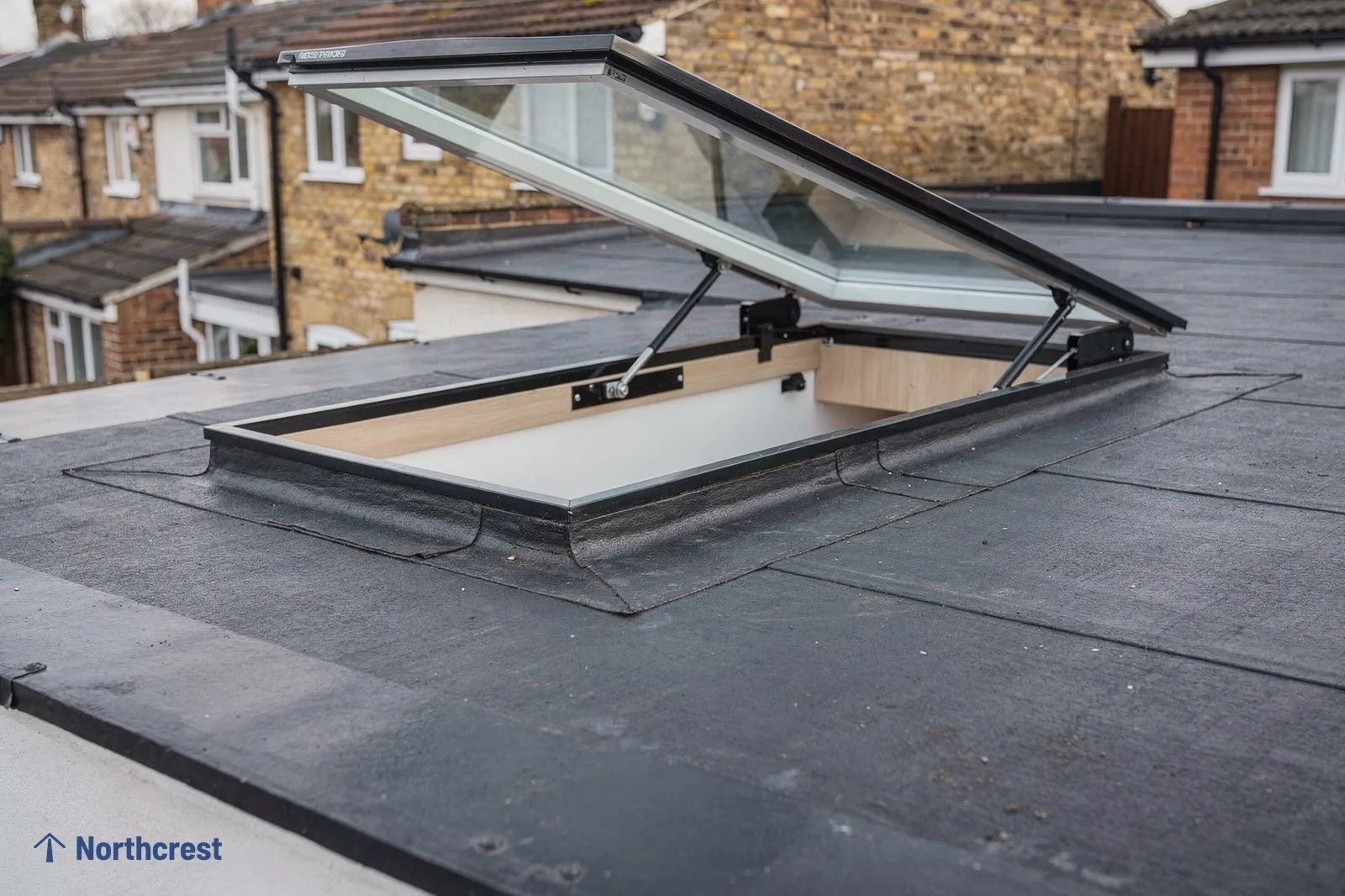
An opening skylight has two lines of defence. The first is the seal around the sash. When the sash closes, it presses onto a rubber or foam gasket, and that gasket keeps rain and draught out at the joint between glass and frame. The second is the weathering around the frame, which sheds water that runs down the roof before it reaches the opening.
On a pitched roof, that weathering is a flashing kit made for the unit and for the covering around it. Slate, concrete tile and clay tile each take their own kit. Each piece of flashing is lapped over the one below so that water runs over each joint rather than into it. On a flat roof, the unit stands on a raised kerb, and the felt, rubber or fibreglass covering is dressed up the kerb and under the frame so that water cannot track in from the roof deck.
When both lines are done right, an opening unit sheds water just as a fixed one does. The gasket is pressed shut each time the sash closes, so a clean gasket in good condition keeps that joint tight.
Where leaks really start
When an opening rooflight does let water in, the cause lies at one of three places: the kerb, the flashing or the seals.
The kerb
On a flat roof, a kerb that is out of level, or low for the covering around it, lets water pool against the frame. A kerb whose insulation has soaked up water from an old leak can stain the reveal below. The covering needs to be dressed well up the kerb sides, and the height of the upstand above the roof surface is part of the specification for each make.
The flashing
On a pitched roof, the flashing is the first place to look. A kit that is wrong for the covering, a lap that was left short, or a tile cut too close to the frame can all let water in at a corner. Roof coverings also move over time, and an old unit that has been re-slated or re-tiled around may have flashing that no longer sits as it was fitted.
The seals
The sash gasket can harden, flatten or come away with age. Dirt and grit caught on it stop the sash closing fully. With an electric unit, a sash that does not travel to the end of its stroke leaves a gap that rain can reach. That is a reason to keep the seal clean and to notice if the glass is no longer closing flush.
What to check if water shows by the frame
Before you decide the unit is leaking, work through these in order.
- Is the sash fully shut? A pole-operated sash can sit a little ajar, and an electric one can stall short of closed.
- Is it condensation? Droplets on the inside of the glass in a damp room are moisture from the air, and they gather on the coldest surface. Our answer on rooflight condensation explains why.
- Is there mist between the two panes? That points to a failed seal in the glass unit and the glass cannot be dried out; it is covered in why rooflight glass mists.
- Does the stain follow rain? A mark that appears only after wind-driven rain, and on one side of the frame, points to a flashing or a kerb detail on that side.
Do not climb onto the roof to look. A torch from inside the loft will show whether the timbers around the opening are damp or stained, and photographs of the glass, the frame, the stain and the date it appeared help when you describe the problem to us.
Electric and solar units
An electric or solar unit adds a motor, but the weathering around the frame is the same as for a manual one. The extra point is travel: the motor has to bring the sash all the way home each time. Where the model carries a rain sensor, it shuts the glass as rain starts, and how a skylight rain sensor behaves is covered separately.
The cable for the motor is routed and sealed as part of the installation. If you are choosing between types, how electric, solar and manual rooflights differ is set out in a guide of its own.
What happens when a unit needs replacing
Where the cause is a worn gasket, a mismatched flashing or a kerb that has failed, the answer is a new flashing set or a replacement rooflight, set into a properly weathered opening. We install and replace. A replacement gives you a fresh seal, a flashing kit matched to the roof and a weathering detail made as one piece of work.
Replacing an existing rooflight counts as notifiable building work. If the replacement is a different size from the old one, the opening alters, and we look at the roof structure around it. The 10-year workmanship guarantee on our installations is described on the guarantee page.
If water has shown by a frame in your house, phone us on 0113 436 0654 to arrange a free survey of an opening or electric rooflight.