Stone and slate roofs on Deepcar's valley-side terraces, with skylights and rooflights to suit
29.2 road miles south of Leeds city centre
Rooflight installation in Deepcar suits stone terraces and cottages on the valley side, with a roof window or sun tunnel serving the inner rooms of a deep, narrow house.
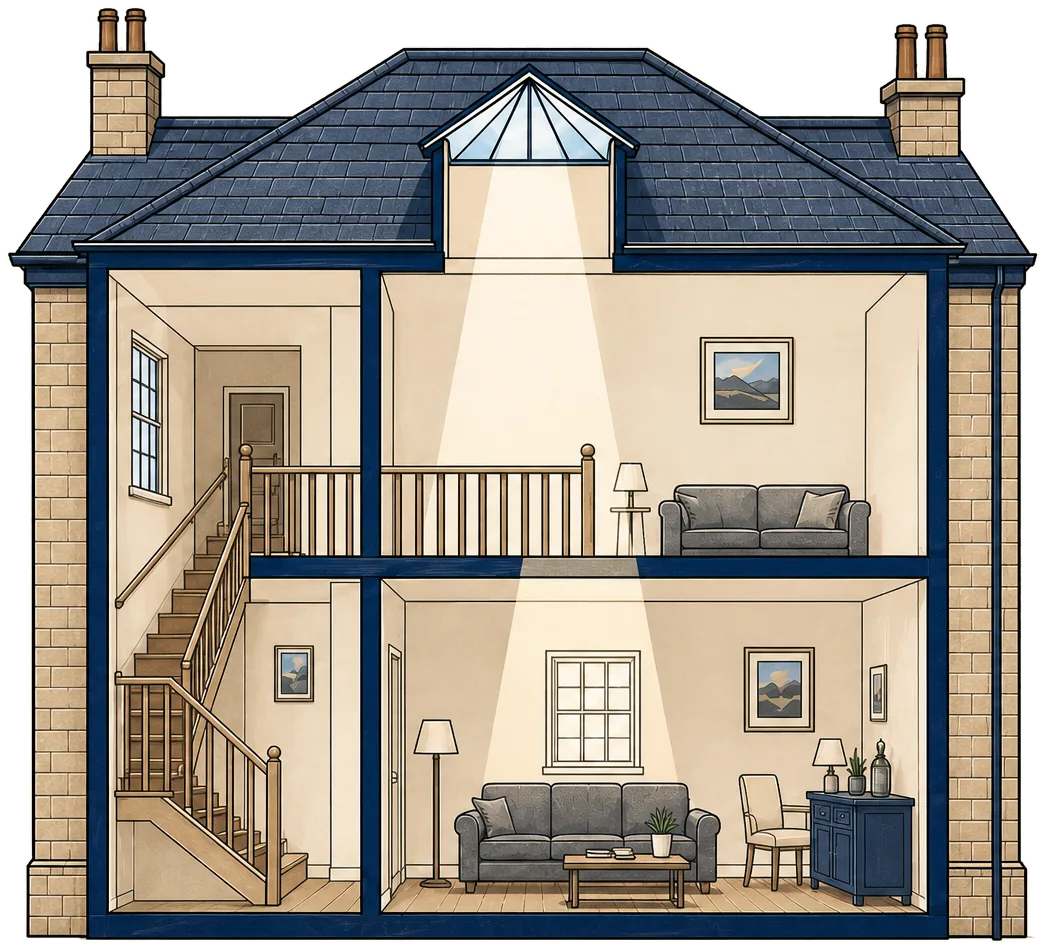
Deep stone houses on the Deepcar valley side
Stone terraces are narrow and deep, with windows front and back and a long stretch of house between them.
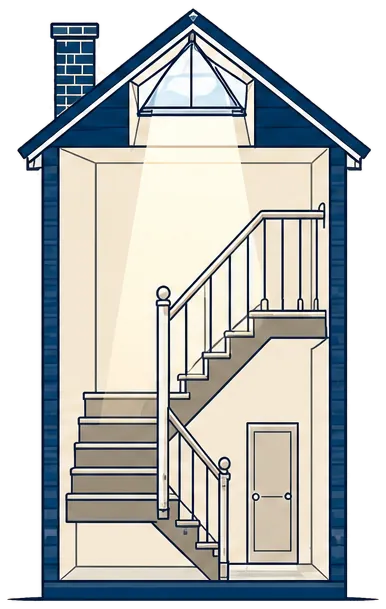 Tall stairwellOn a sloping site the stair can rise a storey more at the back than the front.
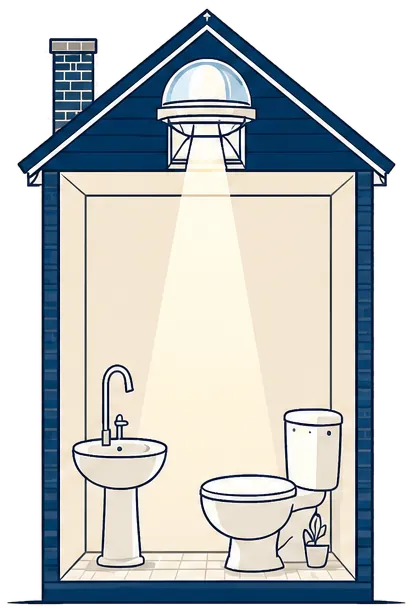 Rear bathroomA bathroom tucked behind the stair in a terrace has its window on a shared yard wall.
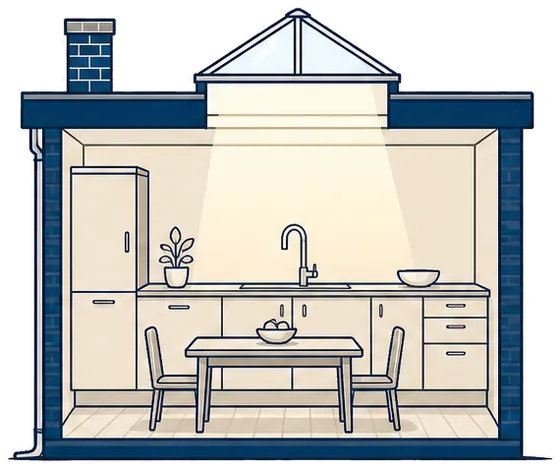 Deep rear kitchenAt the back of a deep terrace the kitchen gets one window and the garden door.
Rooflights for Deepcar's stone and slate roofs
The room underneath sets the unit, then the covering overhead sets the flashing.
-
 Roof Windows
A roof window over a stairwell or into the roof space, framed between rafters and flashed to the slate.
Roof Windows
A roof window over a stairwell or into the roof space, framed between rafters and flashed to the slate.
-
 Electric & Opening Rooflights
An electric opening rooflight above a tall stairwell: a wall switch opens it, and warm air can leave the top of the house.
Electric & Opening Rooflights
An electric opening rooflight above a tall stairwell: a wall switch opens it, and warm air can leave the top of the house.
-
 Sun Tunnels
A sun tunnel for the rear bathroom of a terrace, where the roof sits above and a wall window cannot be added.
Sun Tunnels
A sun tunnel for the rear bathroom of a terrace, where the roof sits above and a wall window cannot be added.
-
 Conservation Rooflights
A slim dark frame lying close to the stone slates, for roofs seen from the street or protected by designation.
Conservation Rooflights
A slim dark frame lying close to the stone slates, for roofs seen from the street or protected by designation.
-
 Energy Efficient Rooflights
Glazing that loses less heat, for stone houses where the roof is the part that cools the rooms below.
Energy Efficient Rooflights
Glazing that loses less heat, for stone houses where the roof is the part that cools the rooms below.
Deepcar questions about slopes and cold stone
The answers cover how a sloping street affects the work, then condensation in old stone, then tall stairwells.
Does the slope of a Deepcar street change how a rooflight goes into a terrace roof?
Skylight installation in Deepcar often means working on a terrace laid out along the valley side. The street steps up or down, and the roofs step with it, so the ridge of one house sits lower or higher than the next. The ground below the back of the house may be a storey lower than the pavement at the front.
Roof levels along the row
Where roofs step down a slope, each house has its own ridge and a stone upstand at the party wall. A rooflight goes into one slope of one house, set well clear of that upstand and of the neighbour's flashing. The position is marked from the loft, where the line of the party wall is easy to see.
Scaffold on a slope
Scaffold legs on a slope need levelling, and the downhill side of a house may need a taller scaffold than the uphill side. A tower or scaffold goes wherever it can stand firmly: a yard at the back, a lane, or the pavement at the front can each be used.
Chimney stacks
A stone terrace can have a chimney stack on the party wall, and the stack limits how much of the slope is free. The best position may sit nearer the middle of the slope than the edge, away from the stack and its lead.
Planning for Deepcar
Sheffield City Council receives any planning enquiry for a Deepcar address. The limits on a roof window under permitted development are on the skylight planning and regulations page, and the address is checked against the council's records of listed buildings and conservation areas.
Reading a stepped terrace
Where the row has listed status or a conservation area around it, how the roofs look from the road matters, and a unit on the back slope is the less visible choice. A conservation rooflight sits low in the covering and keeps the line of the row.
Getting materials up a steep street
On a steep street the van cannot always stop at the door. Slates, flashing and the unit are staged where the vehicle can stand and carried the last stretch, and a long lantern or frame is lifted from the nearest level spot. We plan the carry before the day, since a slope turns a short walk into a long one with a heavy load.
Roofs that were re-slated
Stepped terraces were not always re-roofed together. One house may have fresh blue slate and its neighbour older stone slate, so the covering is read slope by slope. The flashing for each is matched to what is actually there.
Reading a stepped terrace from the loft
Where the party-wall upstand runs, how close the chimney stack sits to the slope, and where the roof level changes from one house to the next.
Will a rooflight cause condensation in an old stone house?
The air inside any house carries steam from cooking, washing and drying clothes. That moisture settles on the coldest surface in the room. In a house with a rooflight, the glass can be that surface.
Why the glass matters
Single glazing is the coldest of all, so an old rooflight runs with water on a winter morning. Modern double glazing holds the inner pane at a higher temperature, and a warm-edge spacer stops the rim of the unit from being the cold line where water forms. Why it happens and what stops it is covered under rooflight condensation.
Ventilation in the house
A bathroom needs its fan or an opening window, and a kitchen its extractor. The glass is not at fault if steam has nowhere to go. An opening roof window lets the room breathe, and an electric one can be worked from a switch.
Fitting the opening
A new opening in the roof structure is notifiable. (We notify Building Control for this.) The insulation around the frame is built up so the lining stays warm. A cold patch of ceiling beside a frame invites condensation, so the reveal is lined and insulated all round.
Telling condensation from a leak
Moisture that clears as the day warms is condensation. A stain that spreads, or a drip that follows rain, points to the flashing. The two have different remedies, and a look at the frame and the covering separates them.
Timbers beside the opening
Damp can sit unseen in the timbers of a stone house, especially near a chimney or an old gutter line. When the slates come off, the rafters beside the opening are looked at, and soft wood is pointed out before the frame goes in. The sound timbers carry the trimmers that frame the opening.
Stone walls and trapped moisture
Thick stone walls change slowly with the weather, so a house can stay cool and damp long after a warm spell. Under the roof, a bedroom with a rooflight can benefit from a trickle vent or an opening sash, which lets moist night air leave instead of settling on the glass.
Where moisture shows up on a rooflight
| Where it appears | What it points to | What helps |
|---|---|---|
| Room side of the glass | Steam meeting cold glass | Better glazing and ventilation |
| Between the panes | A failed edge seal | A new sealed unit or rooflight |
| Stain after rain | A flashing problem | New flashing to suit the slate |
Our stairwell rises through three floors. Which rooflight reaches it?
A house on a slope can be a storey taller at the back than at the front, and the stair rises through the extra height. Daylight reaches the top landing from a gable or roof window, and falls away on the flights below. A rooflight over the stairwell opening sends light down the whole shaft.
Light down a tall shaft
The glass sits at the top of the stairwell, directly above the open well between the flights. Light falls past each landing, and pale paint on the walls carries it further down. A wider unit fills more of the shaft.
Out of reach
A window above a tall stairwell cannot be reached from the floor. Many electric units carry a rain sensor that shuts the glass when showers start, which suits a ceiling nobody can get to. How a unit at the top moves warm air out is described under airing a house through an opening rooflight.
Fresh air through the house
With the unit open, warm air rises out of the roof and cooler air is drawn in lower down. In a house of several floors, that keeps the top landing from stuffiness on a warm day. The effect depends on a window or door being open below.
Where a sun tunnel fits
If the stairwell is closed in with walls and the roof is directly above, a sun tunnel can light the stair. The page setting tube against glass shows how the two compare.
Cleaning the glass
A roof window at the top of a tall stairwell is awkward to clean from inside. A pole with a soft head makes it easier, and a clean pane makes a visible difference to the brightness of the stair.
White walls and landings
Where the walls round the stairwell are painted white or a pale tone, they bounce light down to the hall. Dark panelling or a dark stair carpet soaks it up. That does not change which rooflight suits the house, but it changes how bright the lower flights look, and it is worth deciding before the redecorating.
Size against height
A tall, narrow shaft throws light down in a column, so a wide unit is more use than a tall one. The width of the roof window is limited by the rafter gaps, and where one window will not fill the well, two side by side can be used.
- Myth: A rooflight at the top of the house only lights the top floor.
- Fact: Over an open stairwell, the daylight falls past each landing and reaches the hall.
- Myth: Opening the rooflight lets the heat out of the whole house.
- Fact: Warm air leaves at the top only when a window lower down is open to replace it.
Stocksbridge and the places beyond Deepcar
We also work in Stocksbridge next door, and in Penistone, Birdwell, Chapeltown, Ecclesfield and Hoyland. Ask about a free survey by WhatsApp at 07880 284133.
Deepcar answers about cold stone and tall stairs
Does a rooflight make an old stone house colder?
A modern unit uses two panes, a coated surface and a spacer at the glass edge that conducts little heat, so it loses much less heat than the single pane it may replace. Insulation round the frame keeps the lining warm, and the room below stays steadier than before.
Can a sun tunnel serve the rear bathroom of a terrace?
It can if the roof sits above the bathroom and the tube has a clear run. A terrace bathroom beneath a bedroom is harder, because the tube then passes through that room.
Can one rooflight light two rooms?
Over a stairwell, one unit can serve both the landing and the hall beneath. Two separate rooms, with walls between them, need a unit or a tube for each.
Can an old rooflight in a stone roof be replaced with a conservation unit?
A conservation rooflight can go into the same opening as an old unit, if the size suits. Its frame is slim and dark, with a single bar down the middle in some designs, and it lies low in the slate or stone covering. The range is shown under rooflights for traditional roofs.
Do you fit rooflights in garages and outbuildings in Deepcar?
A garage or workshop with a flat roof takes a rooflight on a kerb. A pitched one takes a roof window laid into the slope, with its flashing matched to the covering.
Get a free survey
- No obligation
- We survey before we price
- WhatsApp or phone, whichever suits
We arrange a survey, then send a fixed written quote. Nothing is booked until you say yes.