The answer
A skylight should be replaced when moisture sits between the panes, when water gets in around the frame, when the seals have gone hard or cracked, or when the room is cold and draughty beneath it. Misted glass cannot be wiped clear, because the sealed unit has failed. Age alone is not a reason, but these signs together are.
When should a skylight be replaced for misting?
Condensation trapped between the two layers of glass is the clearest sign. A double-glazed unit is sealed at its edge, and when that seal fails, damp air gets in and settles on the inner faces of the glass. It shows as a milky haze or beads of water that return after a dry spell, and wiping the outside or inside does nothing, because the moisture is inside the unit.
A failed edge seal also means the unit has stopped insulating as well as it did. The fogging sits between the panes, out of reach, so putting it right means a new glazed unit or a whole new rooflight, and the choice depends on the frame. The mechanism is explained in more detail in why rooflight glass mists.
Moisture on the room-side face of the glass is a different matter. That is condensation from the air in the room, common over a bathroom or a kitchen, and it does not by itself mean the unit has failed. If it runs down the frame and stains the reveal, though, the frame and the ventilation both need a look at the survey.
Water getting in, and stains on the reveal
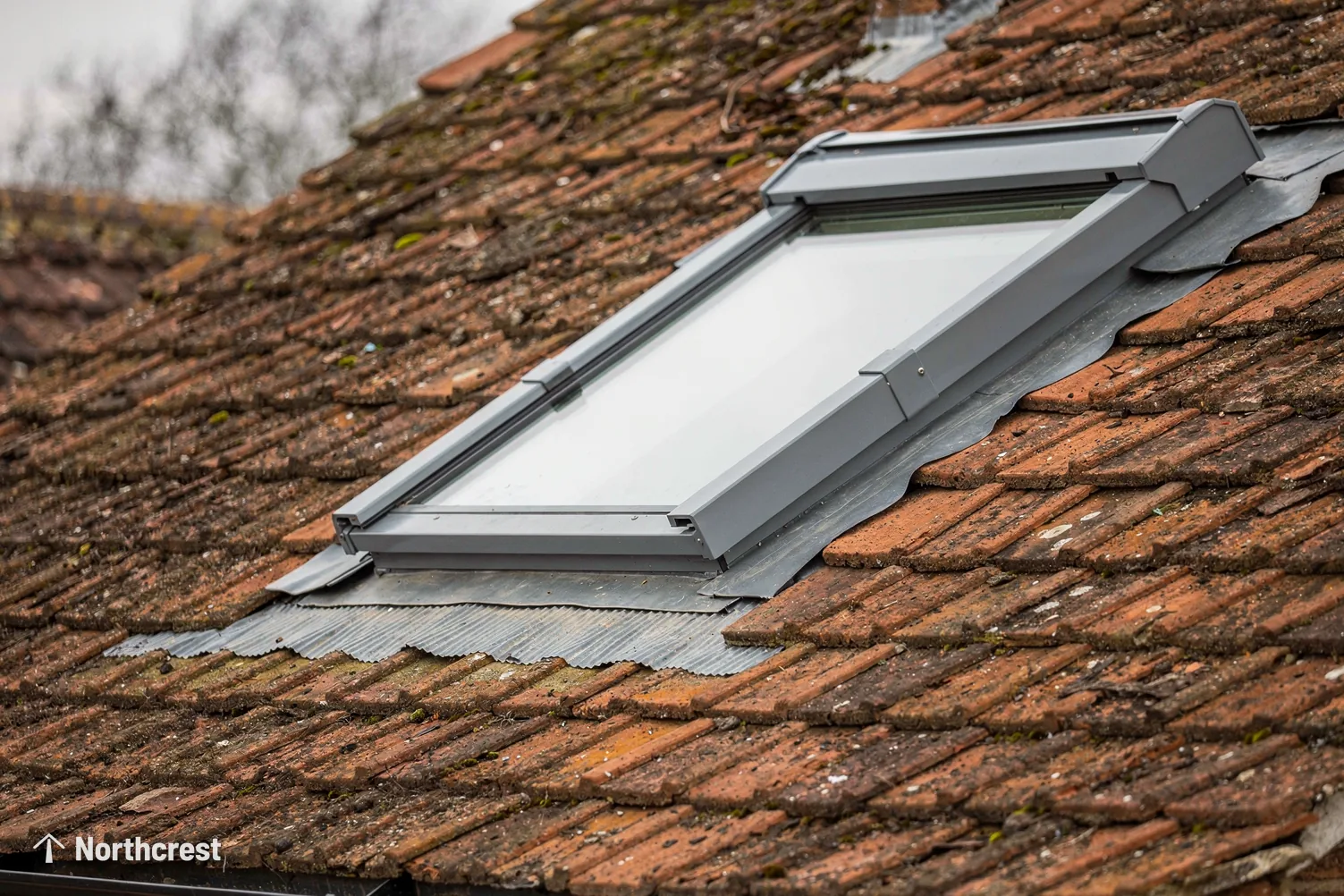
A damp mark on the ceiling next to the rooflight, a brown ring on the plaster around the opening, or paint lifting on the reveal all point to water finding its way in. On a pitched roof the cause is often the flashing where the window meets the slates or tiles. On a flat roof it can be the upstand and the covering around the kerb.
Not every stain starts at the skylight. Water can travel along a rafter from a slipped slate higher up, and a blocked gutter can overflow near a flat rooflight. Look at the stain after a spell of rain and again after a dry week: a stain that grows only in rain points to the roof, and one that grows in cold weather points to condensation.

When the frame has swollen, split or softened in the corners, the timber has taken in water for a long time, and a new unit is the sound answer. That applies most to timber-framed windows that have gone without paint for years.
Tired seals, draughts and a cold room
A rooflight that once closed firmly may no longer sit against its seal. The rubber has hardened or shrunk, the sash has dropped slightly, or the catch no longer pulls the window tight. On a windy day you feel a draught from the glass, and on a cold night the room below is colder than the rest of the house.
Older units also lose heat through the glass itself. Single glazing, or early double glazing with a plain aluminium spacer between the panes, lets more warmth through than the units sold now. A modern replacement has to meet the current Part L limit, which is a U-value of 1.4 W/m²K for a roof window or 2.2 W/m²K for a rooflight, roof lanterns included. A smaller figure keeps more warmth in the room.
Condensation on the inside of the glass every winter morning is another prompt. It shows that the glass is cold, and a better-insulated unit with warm-edge spacers and a low-emissivity coating keeps the inner pane warmer.
Hard to open, cracked or crazed glass
A sash that sticks, a stay that slips or an electric motor that no longer moves the window all make a skylight harder to live with. For an opening rooflight over a hard-to-reach ceiling, a unit that no longer opens takes away the reason for having it in the first place.
Cracked glass, a chip on the outer pane or a laminated layer that has started to cloud are not things to put up with. In a walk-on panel, any damage to the glass matters straight away, since people stand on it. A damaged pane cannot be wiped or tidied; a replacement unit is what puts it right.
Plastic domes on older flat roofs yellow and craze in time. Light through a yellowed dome is duller than it was, and the plastic can become brittle. A dome like that is a candidate for replacement even if it has not leaked.
What to look at before you book a survey
A short check at home gives the survey a head start. Choose a dry day and look at these in turn:
- the glass from inside, for haze or beads of water between the panes
- the ceiling and reveal around the opening, for stains, bubbling paint or a damp smell
- the seals, by closing the window and running a hand around it on a windy day
- the outside, from a window or the ground, for moss, split sealant, slipped slates or tiles, and a covering that has cracked around the kerb
Never climb onto a roof for a closer look, and leave anything that needs getting onto the roof to the survey.
A photograph of the inside and the outside is helpful to have, along with a note of when you first noticed the sign. The free survey then confirms what has failed, and the price you are given afterwards is fixed in writing, for that room and that unit at its measured size. We handle the Building Control notification for a replacement, and the rules on planning and notifiable work for skylights list which jobs call for one.
For what to expect on the price, read how much it costs to replace a skylight. To book a survey, call 0113 436 0654. Our 10-year workmanship guarantee stays with the installation.