
The answer
In the rooflight vs skylight question, the two names point at the same thing: glazing set into a roof. Rooflight is the trade and architects' word, usually heard for glass on a flat roof, and skylight is the everyday word for any of them. Roof windows, lanterns and sun tunnels all sit under either name.
Where each word comes from
Skylight is the older and plainer word. People use it for any window in a roof, whether it sits in a sloping ceiling over a bedroom or in a flat roof over a kitchen. It is what a homeowner types into a search box and what a neighbour calls it over the fence.
Rooflight is the word used on drawings, in building specifications and by the trade. It tends to turn up around flat roofs and extensions, where an architect draws a rooflight over a kitchen or a stairwell, and a builder orders one from a supplier. The two words swap freely in conversation, and a builder who says rooflight and a homeowner who says skylight are usually talking about the same opening in the roof.
We use both words on every page of this site. Our service in Leeds covers both, and the name you use does not change how we survey the room.
Where roof windows, lanterns and sun tunnels fit in
Behind the two names sit four kinds of product, and the names do not line up with them neatly.
- A roof window is set into the slope of a pitched roof, level with the slates or tiles. Part L treats it as a window. VELUX is the best-known make, and other makers sell the same type.
- A flat rooflight is a glass panel or dome set on a kerb in a flat roof. Builders say rooflight; many homeowners say skylight.
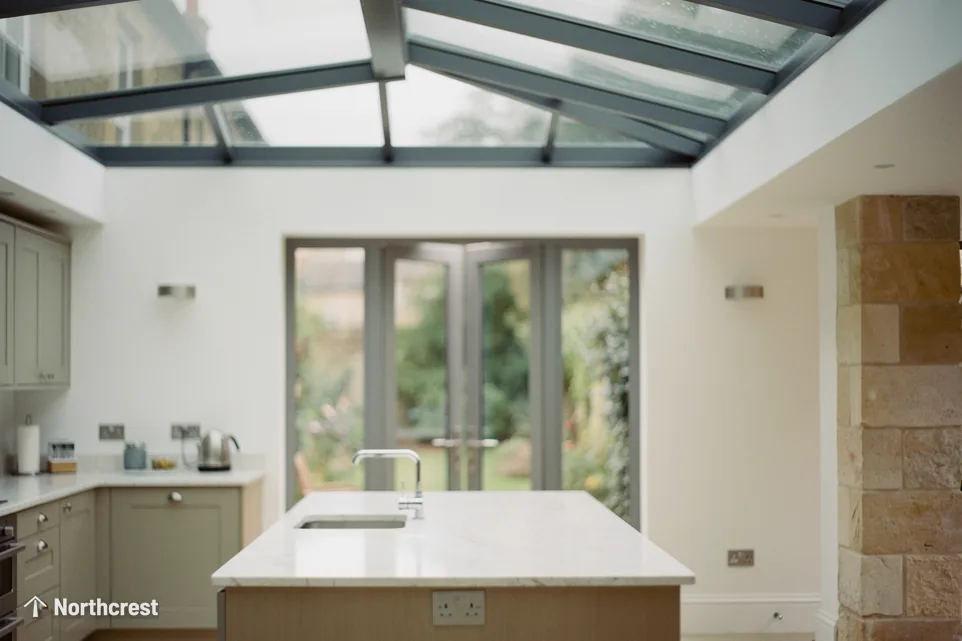
- A roof lantern is a pitched roof made of glass, standing on a kerb over a flat roof. Part L counts it as a rooflight.
- A sun tunnel is a dome, a reflective tube and a ceiling diffuser. It lights a room where a larger opening in the roof is not possible.
Anyone shopping for a skylight might be asking about any of these, which is the reason a first conversation starts with the room instead of the word. Our guide to the types of skylight and rooflight matches each product to the room it lights.
Other names you will see on brochures and drawings
The naming does not stop at two words. Suppliers write "roof light" as two words, call a fixed flat panel a "dome light" and call a roof window a "loft window". On a drawing, a sun tunnel may appear as a "light pipe" or "tubular rooflight". Each of those points back to one of the four products above.
A few building words also turn up next to them. The kerb, sometimes called the upstand, is the raised frame a flat rooflight or a lantern sits on. The flashing is the metal or lead edge that seals a roof window into slates or tiles. The reveal is the inside face of the opening, plastered after the unit goes in. Knowing those three makes a drawing or a conversation with a builder easier to follow.
Why the difference matters for a quote
The name matters less than what the name is being used for. Someone who asks for a skylight might want a roof window in the slope over the stairs, and someone who asks for a rooflight might want a lantern. Neither word tells us the size, the roof it sits in or the room it lights.
Two regulation points make the product type matter. The first is energy. Under Part L, roof windows take the window limit, a U-value of 1.4 W/m²K or Window Energy Rating band B, while rooflights, roof lanterns included, are held to 2.2 W/m²K. The second is planning. A flush rooflight in a house slope is usually permitted development, but a lantern often rises beyond the 150mm limit, so the council's view matters. Both points are set out in our skylight planning and Building Regulations guide.
That is why the written quote we give is fixed and pins down the room, the product and the measurements, instead of leaning on either word. It gives you and us the same picture of what is going in.
Using either word when you ask for a quote
When you contact us, say whichever word you prefer and add the room, and the survey takes it from there. A line such as "skylight over the landing" or "rooflight for the kitchen extension" is enough. Describing what sits above the room, whether slates, tiles or a flat roof, helps further.
Where you are replacing a unit that has misted or started to let water in, say so, and the signs that point that way are covered in when should a skylight be replaced. What sets the price is in our answer on the cost to replace a skylight.
The survey is free, and behind the finished installation sits a 10-year workmanship guarantee. To ask for one, use the quote form.