Skylights and rooflights for moorland-edge stone houses in Meltham
24.9 road miles south-west of Leeds city centre
Skylight installation in Meltham's stone houses beneath the moors, with well-insulated rooflights and roof windows for the rooms that thick walls and a cold hillside leave short of daylight.
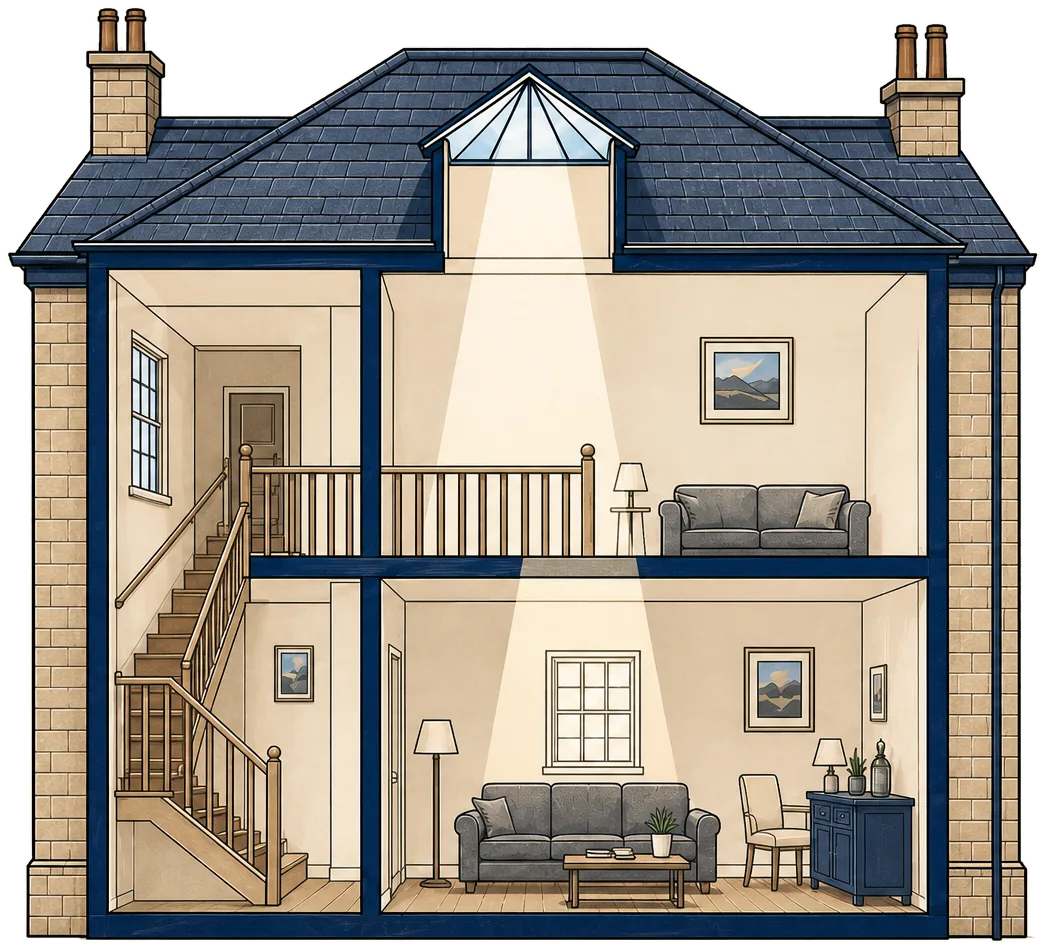
The corners of a Meltham stone house that daylight skips
Deep window openings in heavy walls keep the light near the glass, and the rooms behind get very little.
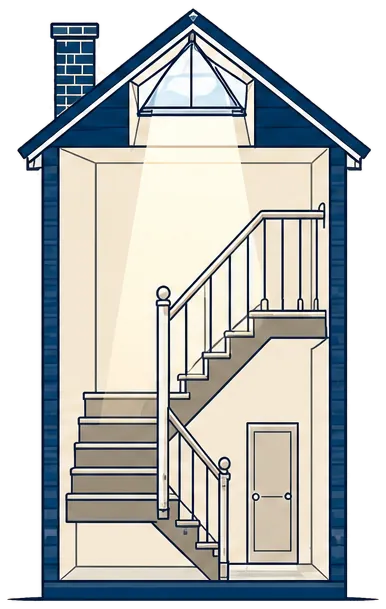 Winding cottage stairA narrow stair turning inside a thick wall has no window until the top.
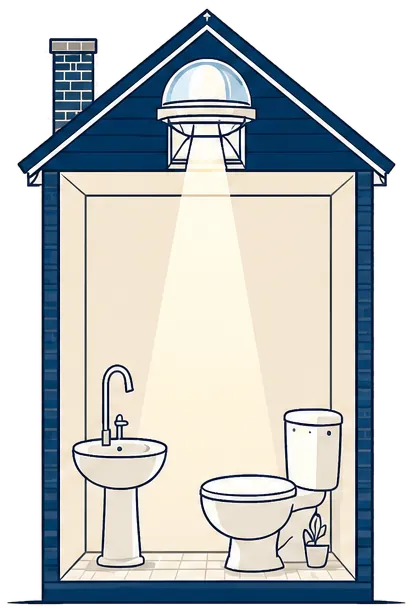 Thick-walled bathroomA bathroom carved out of the middle of an old house has a tiny opening or none.
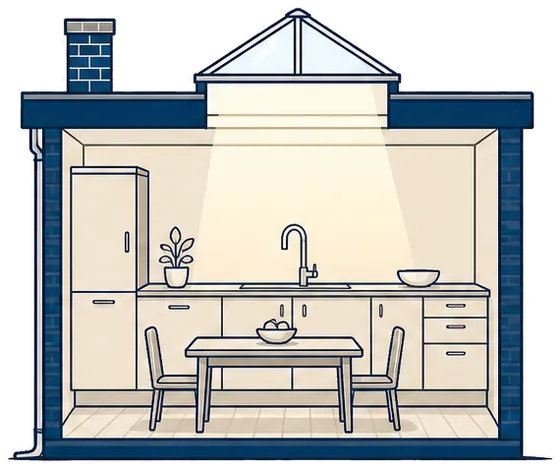 Extension dining areaA dining area at the back of a stone house sits too far from the garden doors.
What suits a Meltham roof and Meltham weather
The cold, wet hillside makes the glazing specification as important as the position of the unit.
-
 Energy Efficient Rooflights
Three panes and a frame with a break in its metal, for a house that takes the wind off the moor.
Energy Efficient Rooflights
Three panes and a frame with a break in its metal, for a house that takes the wind off the moor.
-
 Conservation Rooflights
A slim, low black-framed unit for stone-slate and blue-slate roofs that are seen from the lane.
Conservation Rooflights
A slim, low black-framed unit for stone-slate and blue-slate roofs that are seen from the lane.
-
 Roof Windows
A roof window above the winding stair or an attic bedroom, with a deep light well formed through the thickness of the roof.
Roof Windows
A roof window above the winding stair or an attic bedroom, with a deep light well formed through the thickness of the roof.
-
 Sun Tunnels
A sun tunnel into a windowless bathroom or passage, where the loft above is clear enough for a tube.
Sun Tunnels
A sun tunnel into a windowless bathroom or passage, where the loft above is clear enough for a tube.
-
 Roof Lanterns
A lantern set on the flat roof over a kitchen or dining extension behind an older stone house.
Roof Lanterns
A lantern set on the flat roof over a kitchen or dining extension behind an older stone house.
Meltham answers on cold weather and deep stone roofs
These answers cover glazing for a cold hillside site. They go on to light wells in deep roofs and then to the planning address check.
What glazing holds up on a cold, exposed site like Meltham?
Meltham climbs the hillside toward the moors, and the weather there meets the open moor with little to slow it. A rooflight is a hole in the insulated roof, so it is the part of the roof most likely to feel cold, and the part where moisture will gather first.
Skylight installation in Meltham therefore starts with the glass specification as well as the position. A unit that suits a house in a sheltered town street can be the wrong one for a stone house on an open slope.
What the layers do
Each extra sheet of glass adds a sealed gap, and argon or krypton in that gap passes heat on more slowly than air does. A thin low-emissivity coating on an inner face turns warmth back toward the room. A warm-edge spacer, in a plastic or composite material, stops the metal strip at the glass edge from becoming a cold line.
The frame matters too
A frame with a thermal break has two parts joined by an insulating strip, so cold on the outside does not run straight through to the inside. That keeps the inner edge of the frame warm enough to resist condensation, which can run down a cold frame onto the plaster.
A number to compare
The U-value is the rate at which a unit lets heat through, and a lower figure is better. Part L caps heat loss at 1.4 W/m²K through a roof window and 2.2 W/m²K through a rooflight when either is fitted or replaced in an existing house. A unit chosen for Meltham sits comfortably under those limits and so keeps more warmth than the old one.
Glare and summer
Cold is not the only test. A solar-control coating takes some of the sun's heat out of the light, which helps in a room facing south or west in summer. It is a choice for each room.
Our quote is written down and fixed, recording which room is being lit and the unit with its size, and because fitting or swapping a roof unit falls under the energy rules we notify Building Control.
Fitting it so the heat stays in
Insulation is packed round the frame and lapped onto the roof insulation, and the light well is lined and sealed. A gap in that insulation can cause more heat loss than the glass does, so the fitting counts as much as the unit.
How glazing choices differ on a cold site
| Feature | What it does | Where it counts |
|---|---|---|
| Triple glazing | Adds a third pane and a second gas gap | Bedrooms and living rooms in winter |
| Warm-edge spacer | Cuts the cold line at the glass edge | Rooms prone to condensation |
| Solar-control coating | Takes heat out of strong sun | South and west slopes |
How deep is the light well through a thick stone roof?
The roof of an older stone house is thicker than it looks from the street. The rafters are deep, there may be boarding or felt over them, and any insulation added since sits between and below. The unit goes in at the top of that thickness and the ceiling lies at the bottom, so the opening between the two has a length.
Why the shape of the lining counts
That passage is the light well. If its sides run straight down, the light from the glass meets the lining at a steep angle and little reaches the floor. If they flare out toward the ceiling, the opening at the bottom is wider than the glass at the top, and the light spreads across the room. We cut the lining to flare, and a white finish bounces light on.
Sizing against the gap
A roof window has a size code, and the letter gives the width while the digits give the height. Rafters on either side of the gap frame the opening, so the size chosen has to suit the spacing we find in your roof. In an old stone house the rafters may not sit at regular centres, and the survey records how far apart they are before a size is picked.
Building the well
Timber trimmers frame the opening in the roof, and a short timber box forms the well between the frame and the ceiling. Plasterboard lines it, insulation sits outside it, and the reveal is plastered. The well has to be sealed at the top to stop warm room air meeting cold glass.
When the ceiling is lath and plaster
An old ceiling may be lath and plaster, and cutting through them throws up dust and can crack the plaster beside the cut. We score the line first and support the ceiling while it is opened. Floor and furniture get covered before any cutting, and the room is cleaned when we leave.
Light wells above a stair
A winding stair in a thick wall is a natural place for a roof window, because the well can sit directly over the stairwell. Light drops down the shaft to the turns that never had a window. We look from the loft hatch to check the stair lies under a clear stretch of roof.
Words used for the opening through the roof
- Light well
- The passage between the roof unit and the ceiling opening.
- Splay
- A lining angled outward toward the ceiling so the light spreads.
- Reveal
- The finished, plastered face of the opening inside the room.
- Rafter centres
- The distance from the middle of one rafter to the next.
Which planning office covers a rooflight in Meltham, and what does it look at?
Planning questions about a Meltham house go to Kirklees Council, with one wrinkle: the Peak District National Park boundary runs along the moorland on the town's west side, and a farm or cottage on that edge can sit inside it. The park authority then deals with the enquiry. A postcode lookup settles which applies.
Whether an application is needed at all is set out in our planning permission and Building Regulations guide, which holds the conditions in full so they are not repeated here.
Looking the address up
A map search tells us whether the house is listed, whether its street is protected as a conservation area and which authority covers the postcode. If the map leaves any doubt, we ask the planning office itself and wait for the answer before any unit is ordered.
The slope that faces the lane
Where the question is how the roof looks from outside, the slope counts. A unit on a back slope over a yard is far harder to see than one on the front, and a stairwell or landing can sometimes take its light from either side. That makes the rear slope the first place to look.
A unit that suits blue slate
The conservation rooflight is a slender black frame with the glass close to the slates and often a single bar down the middle. On blue slate or stone slate it reads as a dark line among the slates. Conservation officers often ask for that style, and it also suits a house that is not in a conservation area but is seen from the lane.
Old unit out, new unit in
Taking out an old rooflight and bedding a new one in the same hole disturbs a smaller area of roof than a fresh cut. The new unit still has to meet today's energy limits, and a listed house may need consent even for a swap, so the address check comes first either way.
A flat in a converted building
Flats sit outside the roof-alteration right that houses enjoy, so the council is asked before any work. The roof is shared by the whole building, and the lease shows whose agreement covers the roof.
Putting the answer in the paperwork
When an application is needed, the unit and its size are already fixed, so the council is asked about a definite product in a definite place. That keeps the application short and the reply specific.
What the address check turns up
Listing status, any conservation-area protection on the street, the authority for the postcode and the slope the lane can see.
Around Meltham and down the valley
We work out from Meltham to Slaithwaite, Honley, Holmfirth and Marsden, and into Huddersfield, Kirkburton and Elland. Reach us on WhatsApp at 07880 284133, and the workmanship on every job is guaranteed for a decade.
Questions Meltham homeowners put about cold and condensation
Is a rooflight a cold spot in a stone house in winter?
A well-specified modern rooflight keeps more warmth in than an old single sheet of glass. How well the insulation is packed round the frame determines whether the opening turns into a cold spot, so that part of the work gets the most care.
Why does the glass on my old rooflight run with water?
Water on the inside of the glass is condensation from the room, and a cold frame or an old single pane makes it worse. If the water forms between two panes instead, the sealed unit has failed and needs replacing.
Can a sun tunnel reach a bathroom under a deep roof?
A sun tunnel can work under a deep roof, because the tube runs through the thickness as a straight section. A rigid mirror-lined tube gives a stronger result than a ribbed flexible tube of equal length, so we aim to keep the run straight.
Does an opening rooflight help with damp in a back bathroom?
An opening rooflight lets steam leave through the roof after a bath or shower, which helps the room dry out. It sits alongside the extractor fan, and the two together keep the air moving. A model with a rain sensor closes itself if a shower arrives while the window is open, and the moisture that settles on a cold window is carried off sooner.
Get a free survey
- No obligation
- We survey before we price
- WhatsApp or phone, whichever suits
We arrange a survey, then send a fixed written quote. Nothing is booked until you say yes.