Slate roofs on Huddersfield's sandstone terraces and Victorian villas, lit by skylights and rooflights
17.9 road miles south-west of Leeds city centre
Skylight installation in Huddersfield, from rooflights over tall villa stairwells to units for the long, low roofs of converted mill buildings.
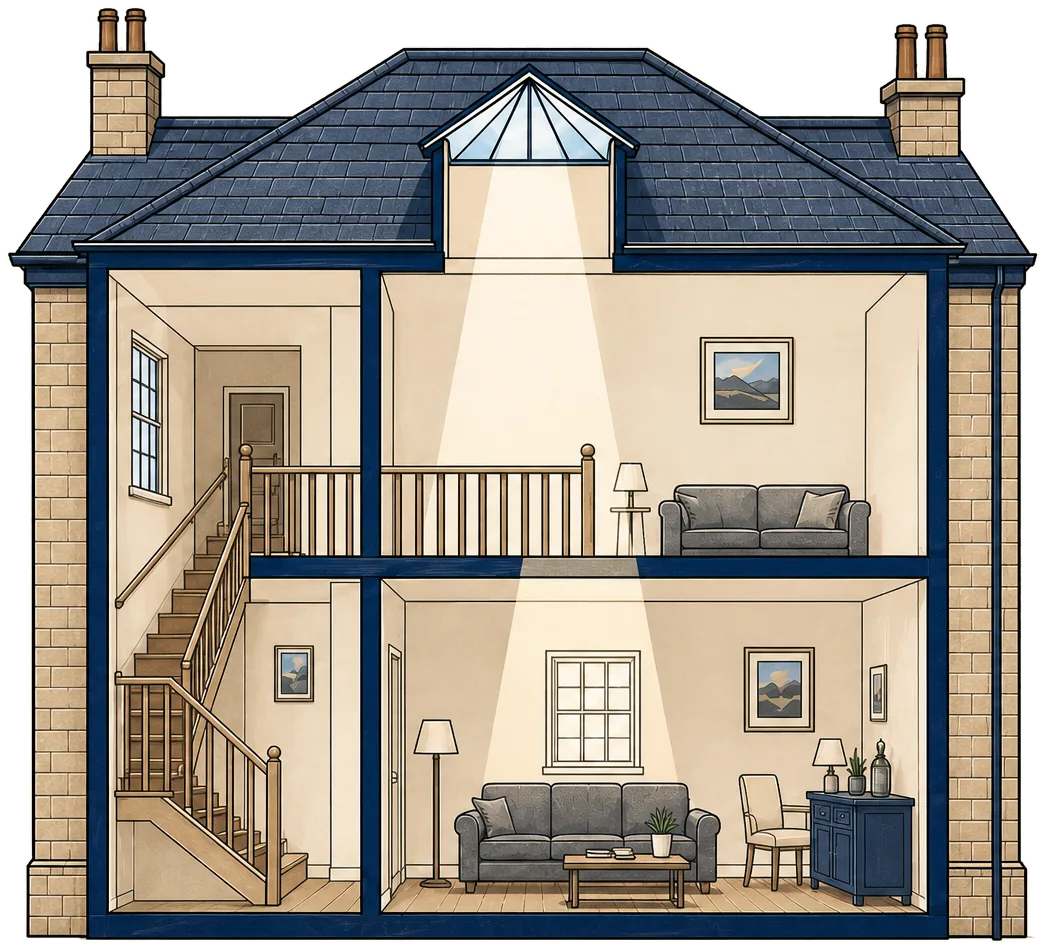
Huddersfield's tall villas and tight terraces leave the middle of the house in shade
Sandstone terraces climb the hillsides in long rows and the villas rise to three floors, so each house has a part that no wall window reaches.
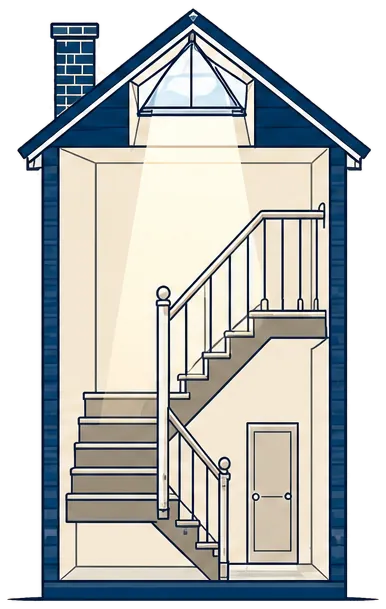 Villa stairwellA tall stair in a Victorian villa climbs three floors with windows only at the far ends.
 Attic bedroomAn attic bedroom under a steep slate slope takes its light from one small window at the gable.
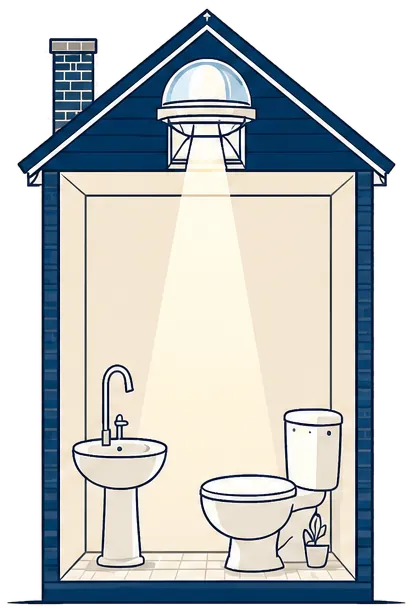 Conversion bathroomA bathroom fitted during a conversion often lands in an inner corner with no outside wall.
Units that suit Huddersfield's sandstone and slate
The room under the roof comes first, then the pitch and weight of the slate, then how much of the roof can be seen from the street.
-
 Roof Windows
A roof window over a villa stairwell or an attic bedroom, with the way it opens chosen for the furniture beneath.
Roof Windows
A roof window over a villa stairwell or an attic bedroom, with the way it opens chosen for the furniture beneath.
-
 Conservation Rooflights
Thin-framed units sit well on slate inside any conservation area that Kirklees has drawn round the older streets.
Conservation Rooflights
Thin-framed units sit well on slate inside any conservation area that Kirklees has drawn round the older streets.
-
 Flat Roof Rooflights
A flat rooflight suits a rear extension or a low mill-building roof, where it can light a deep floor plan.
Flat Roof Rooflights
A flat rooflight suits a rear extension or a low mill-building roof, where it can light a deep floor plan.
-
 Sun Tunnels
A sun tunnel reaches the inner bathroom of a big house where a window cannot, rising through the loft above it.
Sun Tunnels
A sun tunnel reaches the inner bathroom of a big house where a window cannot, rising through the loft above it.
-
 Misted Rooflight Replacement
Fogged glass in an old rooflight over a stair means the seal has gone, and we replace the unit or the whole rooflight.
Misted Rooflight Replacement
Fogged glass in an old rooflight over a stair means the seal has gone, and we replace the unit or the whole rooflight.
Huddersfield questions about villas and mill roofs
They come from the tall Victorian houses of the town and the working buildings that now share its streets with homes.
Our Huddersfield villa has a deep hall and a tall stair. Will one roof window light it?
Skylight installation in Huddersfield often means a villa with a stair that rises through three floors. The wall windows at the ends give some light to each landing, but the middle of the house sits well away from them, and the stair itself is the part nobody can brighten from the side. The roof is the one place where light can enter directly above it.
The idea works because a stair void is an open shaft. Daylight that enters above the top flight falls through the gap between the flights and reaches the landings below, reflecting off the walls as it goes. How far it travels depends on the shape of the shaft, so the first thing we look at is whether the void is open to the roof or closed in by an attic floor.
When the attic floor is in the way
In some villas the stair stops at the second floor, and above it sits a separate attic with its own floor and ceiling. A roof window then lights the attic only. To bring daylight to the stair, a light well is built down through the attic, lined in white plaster and sloped to spread the light. That is more work than a window straight over an open void, and it is the first thing to settle on a visit.
Sizing the unit to the shaft
A bigger window does not always give a brighter stair. The opening has to fit between the rafters and clear the hip or ridge, and the well below it narrows towards the stair. A unit that matches the width of the void gives the best result, and a tall narrow one usually suits a stairwell better than a wide, low one.
A top-hung window is the practical choice here, because no furniture sits beneath it and it hinges clear of the head for reaching the catch. A centre-pivot unit swings its lower half into the room, which matters over a bed but not over a stair.
The hall that is away from the stair
A deep hall that runs back past the stair may stay in shade even with a good window above the flights. A second small unit, or a sun tunnel taking light from a clear part of the roof, can reach that stretch. We look at both options against the roof layout and say which fits.
What the stairwell tells us
Whether the void is open to the roof, how many floors the stair serves, and where the first rafter falls over the top flight.
What do you need to know about the slate on a Huddersfield roof before a window goes in?
Some of Huddersfield's Victorian roofs are Welsh slate, fixed on timber battens over rafters, and older ones may carry heavier stone slate. Welsh slates are thin and overlap each other, and on an older roof the nail holes are often worn. When the slates around the opening are taken up, a few will crack, and a stock of the same size is needed to replace them. We check what is on the roof before the order goes in, so the new slates do not look odd against the old.
Pitch matters as much as the slate. A steep roof sheds water quickly, which suits a window, but it also makes the footing harder, and the work is done from a scaffold or a roof ladder fixed securely at the eaves. Because the opening interrupts the rafters, it is structural work (we notify Building Control).
Streets that climb the hill
Many of the town's terraces are on sloping ground, and the road in front can be steep or narrow. Getting materials up to the roof is a practical matter that we plan on the day. A short cross-street or a back lane may offer a better way in than the front, and the unit is carried up rather than hoisted when space is tight.
Flashing for a thin slate
A flashing kit for slate has a flat apron and narrow side channels, designed to lie close to the slope. The slates beside the frame are cut to a neat line and laid over the edge of the metal, and the slates above are dressed down so that water runs onto the kit and round the frame.
Rafters that have seen a century
An old rafter is often hard timber, and it can have been cut or notched in the past for a flue or a pipe. When the plaster ceiling below is opened, the condition of the timbers is visible, and any doubt about a rafter is dealt with before the frame goes in. The trimming timbers are sized to carry the load, and the frame sits on them.
Chimney breasts and the position of the window
Sandstone houses have stout chimney stacks, and the breast runs up inside the wall below. A window cannot cross a stack, and the breast limits where a light well can go. This often settles which side of the stack a unit sits, and the position is marked out inside the loft before the roof is touched, so the plan on paper matches the rafters overhead.
Roof terms from the survey
- Pitch
- How steeply the roof slopes; steeper roofs shed water faster.
- Notch
- A cut made in a rafter in the past for a pipe or flue.
- Breast
- The thick part of a wall that holds a chimney flue.
- Light well
- The sloped shaft that links a roof window to the ceiling.
We run a small business from an old stone building. Can its roof take rooflights?
Huddersfield grew around its textile trade, and stone buildings from that period still stand among the houses. Some are now workshops, studios, offices or small shops. These buildings often have deep floor plans and few windows on the long walls, so the middle of the floor is short of daylight in the same way as the middle of a terrace.
The permitted development right for roof windows, known as Class C, covers houses. It does not cover a shop or an office, so the planning position is a separate check made with Kirklees Council. If the building is listed, or stands in a conservation area, that applies as well. We take the enquiry to the council for a definite unit in a definite place, which is easier to decide than a general question.
Roofs that are long and low
The roofs of old working buildings are often long and low, sometimes with a flat or very shallow section. A flat rooflight set on an upstand suits a flat section, and a roof window or a conservation rooflight suits a pitched slate one. Where the span is wide, several smaller units spaced along the roof spread the light more evenly than one large one.
Energy rules for a commercial roof
The energy limits for a building that is not a home are set separately from the figures for houses. We check which set applies to the building and choose glazing to meet it. A larger unit or a bank of units means a larger heat-loss area, so the specification of the glass matters more than it would on a house.
Roofs that people may walk on
An old roof may be accessed for maintenance. An ordinary fixed rooflight cannot take a person's weight, so the routes people use on the roof are planned around it. Where someone might have to cross the glass, the right product is a walk-on rooflight, built for walking on, and nothing else should ever be stepped on.
Fitting out around the work
A shop or workshop keeps working, so the zone below the opening is cleared and sheeted before the ceiling is cut. Plaster is skimmed to the new lining and the floor is cleaned afterwards, so the space goes back into use as a workroom or shop again.
Roof sections and the units that suit them
| Roof section | Suitable unit | Why |
|---|---|---|
| Pitched slate | Roof window or conservation rooflight | Sits in the slope with a flashing for slate |
| Flat or shallow | Flat rooflight on an upstand | Water drains round the kerb |
| Long span | Several units in a line | Spreads light along the floor |
Villages and valleys round Huddersfield
From Huddersfield we work in Kirkheaton, Honley, Lepton, Elland, Brighouse, Mirfield, Kirkburton, Slaithwaite, Meltham and Holmfirth. Email info@northcrestskylightsleeds.co.uk with a photograph of the room you want lit.
Huddersfield answers on villas and old mill roofs
Can a bathroom in the middle of a big house be lit from the roof?
A sun tunnel can light a bathroom with no outside wall, provided the tube can run from the roof to the ceiling in a clear line. In a three-storey house that line may pass through the loft, and a rigid tube carries light more efficiently over a longer run than a flexible one.
What makes a conservation rooflight different from an ordinary roof window?
A conservation rooflight has a low profile, a thin dark frame and a fixed pane or a simple opening light, so it lies close to the slates and reads as part of the roof. An ordinary roof window stands a little prouder and has a wider frame, but it is the better choice where the slope is out of sight.
Will an attic bedroom with a roof window get too warm in summer?
A roof window lets in more sun than a wall window of the same size because it faces the sky. Glass with solar control built into it lets less heat into the room, and a blind fitted to the frame shades it, so the unit is chosen with the afternoon sun in mind.
Who is asked about planning for a house in Huddersfield?
Planning questions for Huddersfield go to Kirklees Council, which maps the conservation areas in its area. A listed house must have consent before a rooflight is added, and a flat needs an application for roof alterations, so we raise both points early.
Get a free survey
- No obligation
- We survey before we price
- WhatsApp or phone, whichever suits
We arrange a survey, then send a fixed written quote. Nothing is booked until you say yes.