Skylights and rooflights for the terraces and estates of Knottingley
19.3 road miles south-east of Leeds city centre
Skylight installation in Knottingley for terraces, semis and later estates, aimed at the stair hall, plus new units for rooflights that have misted.
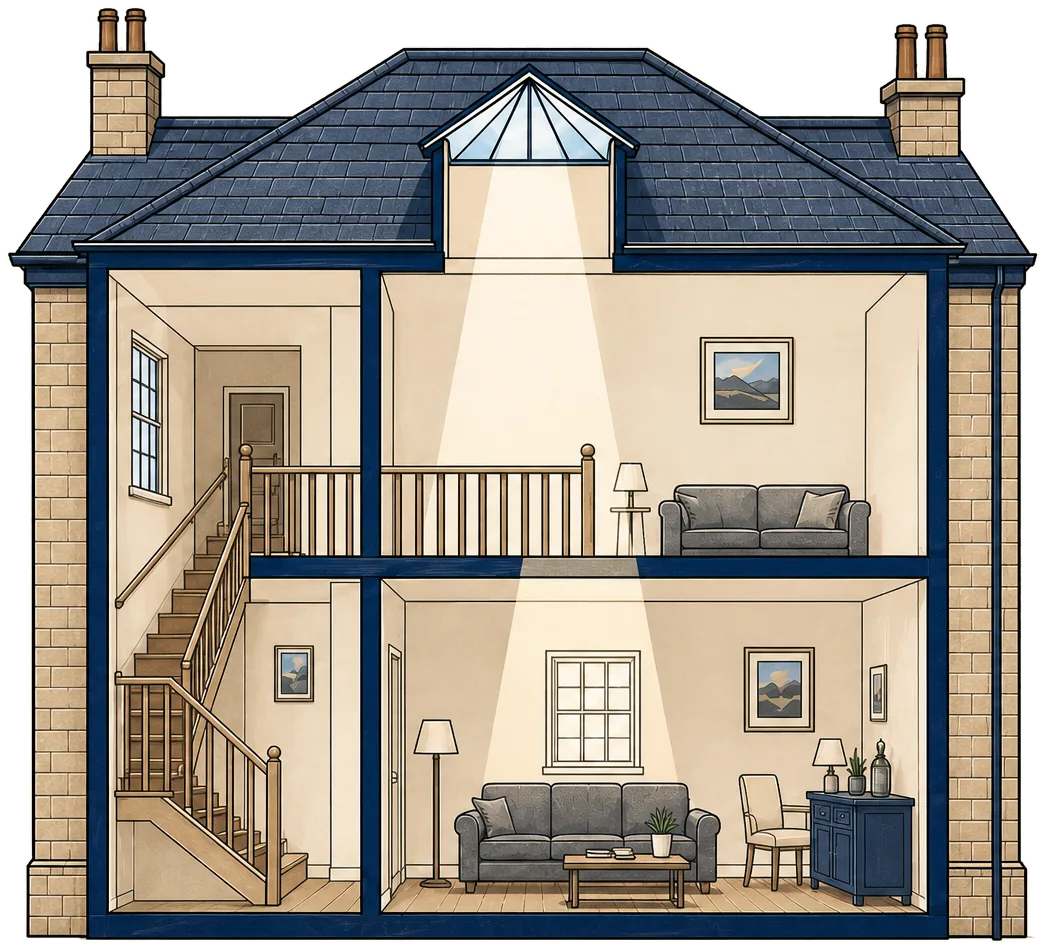
Where Knottingley's terraces and estate semis stay short of daylight
Wall windows in the terraces and estate semis leave the stair and the small rooms around it short of light.
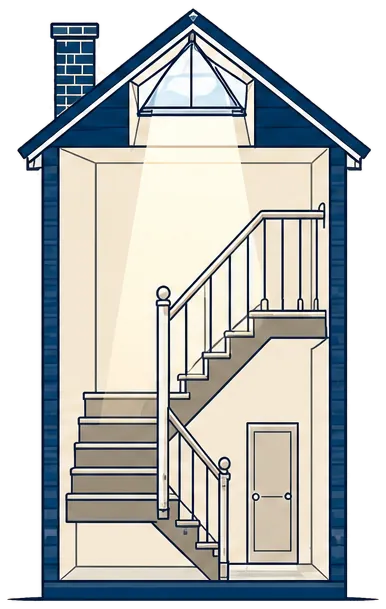 Stair hallA semi's stair hall has one small window at the half-landing, so the hall and landing stay shaded.
 Box roomA terrace's box room sits between two bedrooms, with a small window facing a neighbour's wall.
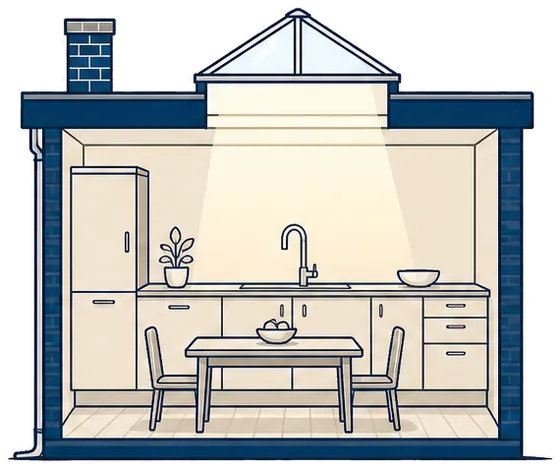 Clouded extension rooflightA flat-roofed back extension keeps an old rooflight whose misted glass dulls the room below.
Matching units to Knottingley's tile and slate roofs
The room comes first, then the roof covering over it, whether slate on an older row or concrete tile on a later estate.
-
 Misted Rooflight Replacement
A rooflight with misted glass has a failed seal; fresh glazing, or a replacement rooflight outright, takes its place, often in the same opening.
Misted Rooflight Replacement
A rooflight with misted glass has a failed seal; fresh glazing, or a replacement rooflight outright, takes its place, often in the same opening.
-
 Sun Tunnels
A sun tunnel serves a windowless bathroom or hall when the roof is overhead and the tube can run straight.
Sun Tunnels
A sun tunnel serves a windowless bathroom or hall when the roof is overhead and the tube can run straight.
-
 Roof Windows
A roof window over a semi's stairwell, set in a short hipped or gabled slope of concrete tile.
Roof Windows
A roof window over a semi's stairwell, set in a short hipped or gabled slope of concrete tile.
-
 Flat Roof Rooflights
A flat rooflight suits a flat-roofed back extension or garage; the covering on the roof sets the upstand it needs.
Flat Roof Rooflights
A flat rooflight suits a flat-roofed back extension or garage; the covering on the roof sets the upstand it needs.
-
 Energy Efficient Rooflights
An old rooflight from decades ago is far less efficient than a unit built to today's Part L figure of 1.4 or 2.2 W/m²K.
Energy Efficient Rooflights
An old rooflight from decades ago is far less efficient than a unit built to today's Part L figure of 1.4 or 2.2 W/m²K.
Knottingley questions on misted rooflights and permission
The questions here start with misted rooflights and then move to the stair hall of a semi and the bathroom with no window.
My rooflight has misted over, so do you replace just the glass or the whole unit?
A rooflight put in years ago, in an extension or a loft conversion, can be timber, uPVC or aluminium. When mist appears between the two panes, moisture has got into the sealed gap and cannot get out again. Wiping the inside or the outside does nothing, because the moisture is sealed between the panes. The answer is fresh glazing or a new rooflight.
Which of the two applies depends on what holds the glass. We replace the lot where the frame has aged badly; where it is sound, a new sealed unit can go into it. We look at the frame and the glass together on the roof. Whichever it is, the room gets its full daylight back, because clear glass lets through more than a unit that has clouded over between the panes.
Misting often creeps on slowly, so it is easy to put up with, and the light lost is easy to miss until the new unit goes in.
Reading the old frame
A frame that is stained, soft or out of square is a warning. Timber that has gone soft will not hold a new unit for long. A uPVC or aluminium frame that is straight and clean may take new glass, if the beading comes away without damage and the replacement unit is the same thickness. A mismatch in thickness leaves a loose pane.
The kerb and the covering
On a flat roof the rooflight sits on a kerb, and the roof covering is dressed up its sides. If the kerb is damp or the covering round it has split, putting new glass on top does not help, so we look at the whole detail: kerb, covering and glass. Where the kerb is sound, a new unit sits on it and the covering is left as it is.
Meeting today's standard
A replacement rooflight has to meet the energy limit set for new elements in an existing house. For a rooflight that is a U-value of 2.2 W/m²K, and for a roof window 1.4 W/m²K or Window Energy Rating band B. A unit from a few decades ago may fall short of those, and the new glazing, with its coating and warm-edge spacers, holds heat in much better.
What we record on the roof
On the roof itself we note the size of the old unit, how it is fixed, what the covering is made of and whether the upstand rises cleanly all round. Photographs of the underside from the loft show the framing around the opening. Together these tell us whether the swap is a quick like-for-like job or whether something behind the glass needs attention first.
Swapping for a bigger one
If the room is gloomy, a replacement is a chance to ask for a larger unit. A bigger opening alters the roof structure, because timbers are framed round it, so it is quoted as new work.
- Myth: Misting just needs the unit drying out.
- Fact: The moisture is trapped between sealed panes, so it returns until the unit is replaced.
- Myth: A misted rooflight always means a whole new frame.
- Fact: A sound frame can often take a new sealed unit, and we say on the roof whether yours can.
How do you light the stair hall of a semi in Knottingley?
Knottingley has terraced streets, semi-detached houses, estates built after the war and newer streets since. In a semi of that kind the front door opens into a hall, the stair rises beside it, and a single window on the half-landing is all that lights the whole stack.
A roof window above the upper landing sends daylight down the stair void, and the hall at the bottom gains from it. Where the slope over the landing is short, because the roof is hipped, a sun tunnel makes better use of the space than a window would.
Trusses in later roofs
Roofs built later in the twentieth century are often made with trussed rafters, factory-made timber frames that replaced rafters cut on site. A truss cannot simply be cut, so a new opening needs the structure around it altered and checked. This is part of why we look into the loft first.
The hip and the landing
On a hipped roof the end slopes are short. The slope above a landing may not have room for a window with its flashing and a clear gap round it. A sun tunnel dome is a good deal smaller, and the tube can be angled to reach the ceiling opening.
Reading the loft from the hatch
The loft hatch is usually on the landing, which makes it the best place to start. Standing in the hatch, we can see how the roof timbers run, whether the roof is trussed or cut, where the chimney breast is and how much boarding or stored furniture lies between the hatch and the spot above the stair. Everything is measured before a unit is chosen.
Concrete tile and the flashing
Concrete tiles are deeper than slate and need a flashing kit shaped to that depth. Using a kit made for a flatter covering leaves gaps along the sides of the frame. We note which tile is on the roof so the right kit is chosen.
Roof words from a stair survey
- Hip
- The sloping end of a roof where two slopes meet at an angle instead of a gable wall.
- Trussed rafter
- A factory-made timber frame that forms a roof, used in place of rafters cut on site.
- Light well
- The lined shaft between a roof window and the ceiling opening below it.
- Diffuser
- The ceiling panel on a sun tunnel that spreads the light into the room.
Can a bathroom with no window be lit from the roof, and does that need permission?
A windowless bathroom turns up in houses where a bedroom has been split or a landing partly taken over. It is lit by a bulb all day, and the fan runs. A sun tunnel suits it well, since it needs no wall: a dome sits on the roof, a mirror-finish tube drops through the loft, and a diffuser spreads the light from the ceiling.
Planning is usually a short question. A dome stands only a little above the covering, and an ordinary house can usually take one as permitted development. The conditions, such as the 150mm limit on how far a rooflight projects, are laid out in our skylight planning guide, and Wakefield Council is the authority for Knottingley.
Where the tunnel can go
A straight, unobstructed line from the roof to the ceiling is what the tube needs. A bathroom under the roof, as in a bungalow or the top floor of a house, can be reached this way. A bathroom below a bedroom cannot, because the tube would have to pass through the room above. A look from the loft tells us quickly whether the roof can serve the room.
Rigid or flexible
A rigid tube carries light further and more cleanly than a flexible one over the same run, so it is the first choice wherever the run allows. A flexible tube is useful for a jog round a joist or a purlin, where a straight line will not fit.
The fan stays
A sun tunnel brings light to a bathroom and nothing more. It does not replace the extractor fan, which still clears steam from the room, so the fan stays wired and working. The two do different jobs, and fitting a tunnel does not change the ventilation the room already has.
Rafters and joists
A sun tunnel is usually small enough to pass between the rafters. Cutting through a rafter or joist makes the job structural, which is notifiable, so we notify Building Control. The quote for the tunnel is fixed in writing.
What stands between roof and bathroom
Whether the bathroom lies directly under the roof, which way the rafters and joists run above it, and what stands in the way of a straight tube.
Down the Aire and into Pontefract
Alongside Knottingley we work in Ferrybridge, Pontefract, Castleford, Featherstone, Allerton Bywater, Sherburn in Elmet and Ackworth Moor Top. To arrange a free survey, ring 0113 436 0654.
What Knottingley homeowners ask about replacement units
Is a new rooflight more efficient than the one it replaces?
A unit built to today's Part L standard loses much less heat than one fitted decades ago. Double or triple glazing, a low-emissivity coating, warm-edge spacers and a thermally broken frame all lower the U-value, and the lower the figure, the less heat escapes through the glass.
Does an electric opening rooflight suit a landing ceiling that is hard to reach?
An electric opening rooflight is opened by a switch or remote, which suits a ceiling too high for a pole. Rain sensors, found on many models, close the rooflight again if a shower starts. They also help ventilate a landing that gathers warm air.
Which makes of roof window do you fit?
We fit VELUX windows and other makes, and the one chosen is the one that suits the roof, the room and the size we find on the roof. We do not tie the choice to a single manufacturer, and the written quote names the unit it covers.
Where is the size code on an old VELUX window?
Look for the data label on the sash or the frame, where a code such as the MK04 style gives the width as a letter and the height as digits. Send us the code, or let the survey read it, and we can see which replacements share that opening.
Get a free survey
- No obligation
- We survey before we price
- WhatsApp or phone, whichever suits
We arrange a survey, then send a fixed written quote. Nothing is booked until you say yes.