Skylights and rooflights for gritstone terraces and villas in Keighley, over stair, attic and flat roof
24 road miles west of Leeds city centre
Skylight installation in Keighley's gritstone terraces and Victorian villas, with rooflights for steep stairs and the rooms in the roof, plus small commercial jobs.
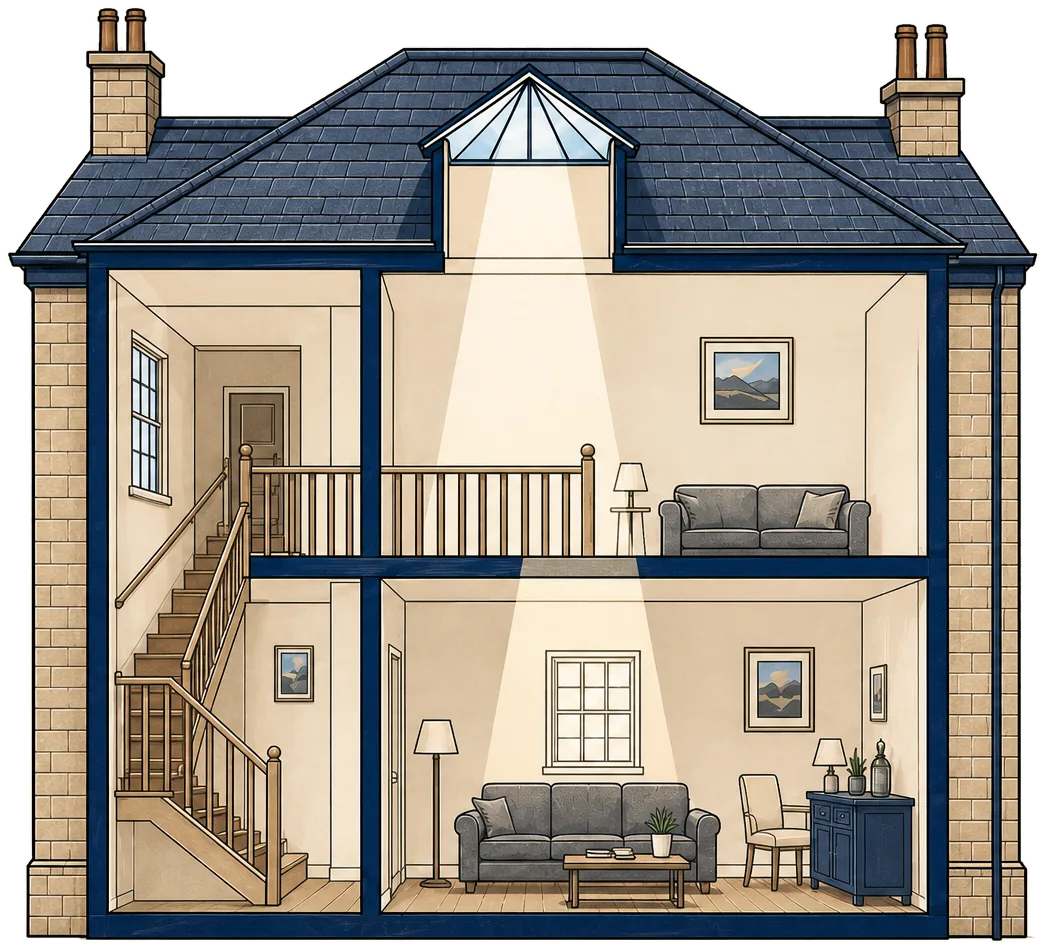
What a Keighley mill-town house leaves unlit
Gritstone walls, narrow plots and steep streets give the older houses some stubborn rooms.
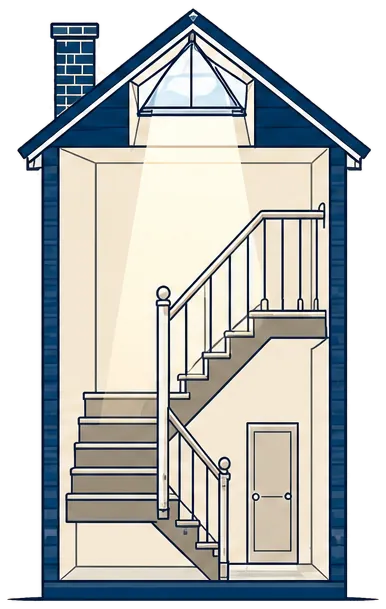 Steep narrow stairA flight climbing between thick stone walls catches light from the top window only.
 Attic bedroomA room in the roof has a small window and a ceiling sloping down to the floor.
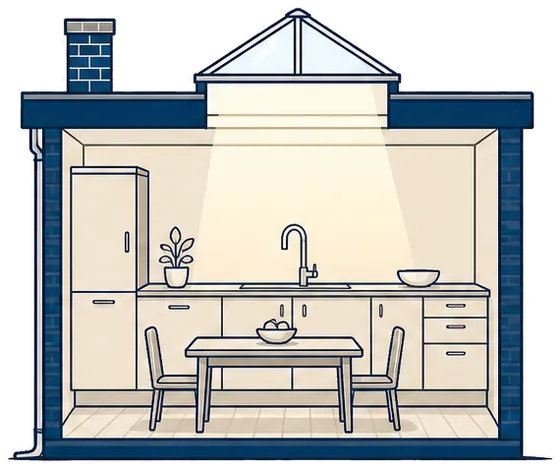 Rear kitchen extensionA kitchen added behind a terrace sits a long way from the front windows, under a flat roof.
What suits Keighley's roofs and the people who live under them
Slate and stone on the pitched roofs, felt and rubber on the flat ones, and workshops standing among the houses.
-
 Roof Windows
A roof window above a steep stair or in an attic room, framed into the main slope.
Roof Windows
A roof window above a steep stair or in an attic room, framed into the main slope.
-
 Conservation Rooflights
Low slim frames for stone houses in the older streets, where roof lines matter.
Conservation Rooflights
Low slim frames for stone houses in the older streets, where roof lines matter.
-
 Flat Roof Rooflights
A flat rooflight for the roof of a back extension, workshop or shop unit.
Flat Roof Rooflights
A flat rooflight for the roof of a back extension, workshop or shop unit.
-
 Energy Efficient Rooflights
Modern glazing and insulated frames in place of single-glazed units on solid-walled stone houses.
Energy Efficient Rooflights
Modern glazing and insulated frames in place of single-glazed units on solid-walled stone houses.
-
 Walk-On Rooflights
A glass panel set level in a roof terrace or yard floor to light a room below.
Walk-On Rooflights
A glass panel set level in a roof terrace or yard floor to light a room below.
-
 Electric & Opening Rooflights
A unit you open by switch over a high stairwell or a room with a hard-to-reach ceiling.
Electric & Opening Rooflights
A unit you open by switch over a high stairwell or a room with a hard-to-reach ceiling.
What Keighley owners ask about steep streets and stone walls
These questions cover access on a hillside street, then warmth in a stone house, then light in a working building.
How do you work on a Keighley terrace on a steep street?
Keighley climbs from the river up the valley sides, and some of its terraces stand on streets with a real gradient. A house at the top of a street may have a back yard far below its front door. One lower down may have a roof you can see from the pavement across the road.
Those details affect how a rooflight goes in. They do not change what the room needs, but they do change how the work is staged, and the survey is where that gets sorted out.
Getting to the roof
With neighbours either side and no passage down the flank, everything for a mid-terrace job comes through the house or over the roofs. We look at whether the front or the back is the better side to set up on, where a ladder or scaffold tower can stand level, and how a pane of glass travels from the road to the slope. A back yard on a different level from the front can make the rear slope the easier one.
Choosing the slope
The choice of slope is a planning question and a light question as well as a practical one. A rear slope is not seen from the street, which usually simplifies the planning question, and it often lights the stair just as well. The front slope may face the sun, which helps a dim landing.
Dust sheets and a clean stair
On a narrow terrace the stair is also the way in and out, so protecting it matters. Sheets go down on the treads and the floor below the opening before the ceiling is touched, and the hall is brushed and cleaned when the reveal is finished. A steep flight is worth covering carefully, because one slip is easy on bare treads.
Roof pitch
Each roof window maker states the range of pitches its units suit, so a steep roof or a shallow one narrows the choice of unit. A steep pitch also affects how the flashing is laid and how the slates are cut around the frame. We note the pitch at the survey and choose the kit for it.
Planning
Bradford Council is the planning authority here. Whether your house can add a rooflight without an application depends on its type and its street, and the conditions that apply are explained in our planning page for roof alterations.
Setting up on a sloping street
Where a ladder can stand, whether the rear slope is easier to reach than the front, and the pitch of the roof at the spot above the stair.
Will a new rooflight make my stone house colder?
The older gritstone houses of Keighley have thick solid walls, and the roof is often the weakest point for heat. An old rooflight with a single sheet of glass loses more warmth than the slates around it. Fitting a modern unit in its place usually improves matters.
What the figures mean
The U-value measures heat lost: the lower the number, the less leaves the room. Part L sets 1.4 W/m²K for a new roof window, or Window Energy Rating band B, and 2.2 W/m²K for a rooflight. Double or triple glazing with a warm-edge spacer and a gas fill is how a unit reaches those figures, and low-emissivity coatings send heat back into the room.
Why the frame matters as well
Glass is only part of it. A frame with a thermal break, which separates the inner and outer metal, stops warmth leaking through the frame. The lining of the light well is insulated, so the reveal stays warm to the touch.
Condensation
Stone houses can be damp, and a cold surface in a damp room collects moisture. A well-insulated unit with a warm inner surface collects far less. Wet on the glass can also come from the room itself, from baths, cooking and drying clothes indoors, and an opening rooflight lets that moisture out. Where the window is the only source of ventilation in the room, an opening unit helps more than a fixed one.
Damp walls and the roof line
A solid stone wall soaks up rain and gives it back slowly, so a stone house can feel cool even in a dry spell. The roof, by contrast, is a dry, light surface that you can insulate properly. Putting glazing there brings daylight without adding to the problems of the walls, which are best left as they are. The room below a new rooflight gets a new reveal and a lining that is part of the insulated build-up.
Summer sun
An attic under a south-facing slope can warm up fast. Solar-control glass reflects part of the sun's heat, and a blind inside or outside takes more. We discuss orientation at the survey so the glazing is chosen for the slope.
Old units and new ones side by side
An older rooflight in a stone house may be a metal-framed unit with a single sheet of glass, set into a kerb that has been re-sealed more than once. Taking it out and fitting a modern unit in the same opening is a straightforward job. The new frame comes with its own flashing and lining, so the whole detail is renewed.
We choose the unit with the glass, the frame and the lining all in mind, because each of the three affects how much heat the opening loses.
Part L limits for new units
| Unit | U-value limit | Or |
|---|---|---|
| Roof window | 1.4 W/m²K | Window Energy Rating band B |
| Rooflight, including a lantern | 2.2 W/m²K | No alternative band |
Can a workshop, shop or small office in Keighley have a rooflight?
Keighley has a long history of mills, workshops and small trade units, and working buildings sit between the terraces. A shop with a stockroom behind it, a joiner's workshop under a felt roof or a studio in a converted mill all share a need: more light at the back than the front window can give.
What a working roof looks like
Workshop and unit roofs are often flat, covered in felt or rubber, or a low pitch of profiled sheet. A flat rooflight on a kerb suits the first. On a sheeted roof the unit has to match the profile, and we look closely at what the roof is made of before a unit is chosen.
Planning and use
The permitted development rights for roof alterations in Class C are written for dwelling houses. A shop or workshop does not automatically have them, so for a commercial building the question goes to Bradford Council from the start. The unit and its size are set down before that conversation, which makes it a short one.
What the light does for the work
Natural light over a bench or a desk makes it easier to see colour and detail. A fixed unit gives daylight alone; where fumes or heat build up, an opening unit lets them out.
Glass in the yard floor
A yard or terrace that sits above a room can take a walk-on rooflight: a flat glass panel which its maker rates for people to stand on. It lies level with the paving and lights the room beneath, such as a cellar office or a store. The rating belongs to the maker, and the panel is picked to suit how the area is used.
What visitors see
A shop or studio that welcomes visitors benefits twice from a rooflight. The back area looks cleaner and more open when daylight falls across it, and a rooflight over a counter or a display table lights what you want people to see.
A commercial quote is fixed in writing, just as a house quote is.
Working-roof words
- Profiled sheet
- A roof covering of corrugated or ribbed metal or fibre sheets.
- Kerb
- A raised frame on a flat roof that a rooflight sits on.
- Walk-on rooflight
- A glass panel rated by its maker for people to stand on.
- Class C
- The part of permitted development covering roof alterations on houses.
Keighley and the villages up the valley
From Keighley we reach Oakworth, Steeton, Bingley, Haworth, Silsden, Wilsden, Crosshills and Ilkley. Workmanship on each Keighley job is guaranteed for ten years, as the guarantee page explains, and WhatsApp on 07880 284133 is the quickest way to arrange a visit.
Short answers for Keighley homes and workplaces
Which side of the roof is best for a stair rooflight?
The slope directly above the stair is the best position, because the light drops straight down the flight. Where both slopes are possible, the rear one is easier for planning and the front one may catch more sun. We weigh the two against the rafters and the stair layout.
Can an old VELUX be replaced with the same size?
A VELUX or another make can be replaced like for like. The size code on the old frame tells us what fits the opening, and the new unit comes with fresh flashing, so the roof round it is weathered again as part of the job.
Can a rooflight be fitted in a house with a stone slate roof?
Stone slates are heavy and uneven, so they are lifted course by course and laid back around the frame, with a low-profile unit chosen to sit close to them. We check the roof timbers and the condition of the stone before a position is picked, and any slate that cracks in the lifting is replaced with a stone of similar size.
Who looks after notifying Building Control?
For notifiable work we notify Building Control, at Bradford Council or with a registered building control approver.
Does a rooflight on a front slope upset the look of the street?
A slim frame set low in the slates sits quietly in the roof, and the effect is stronger when units line up with the windows below. On a terrace, the rear slope usually avoids the question altogether.
Get a free survey
- No obligation
- We survey before we price
- WhatsApp or phone, whichever suits
We arrange a survey, then send a fixed written quote. Nothing is booked until you say yes.