Skylights for older village houses in Darfield, and rooflights for bathrooms and back bedrooms
27.2 road miles south of Leeds city centre
Skylight installation in Darfield's older village houses and later estates, with rooflights for bathrooms under the eaves and for back bedrooms that have become home offices.
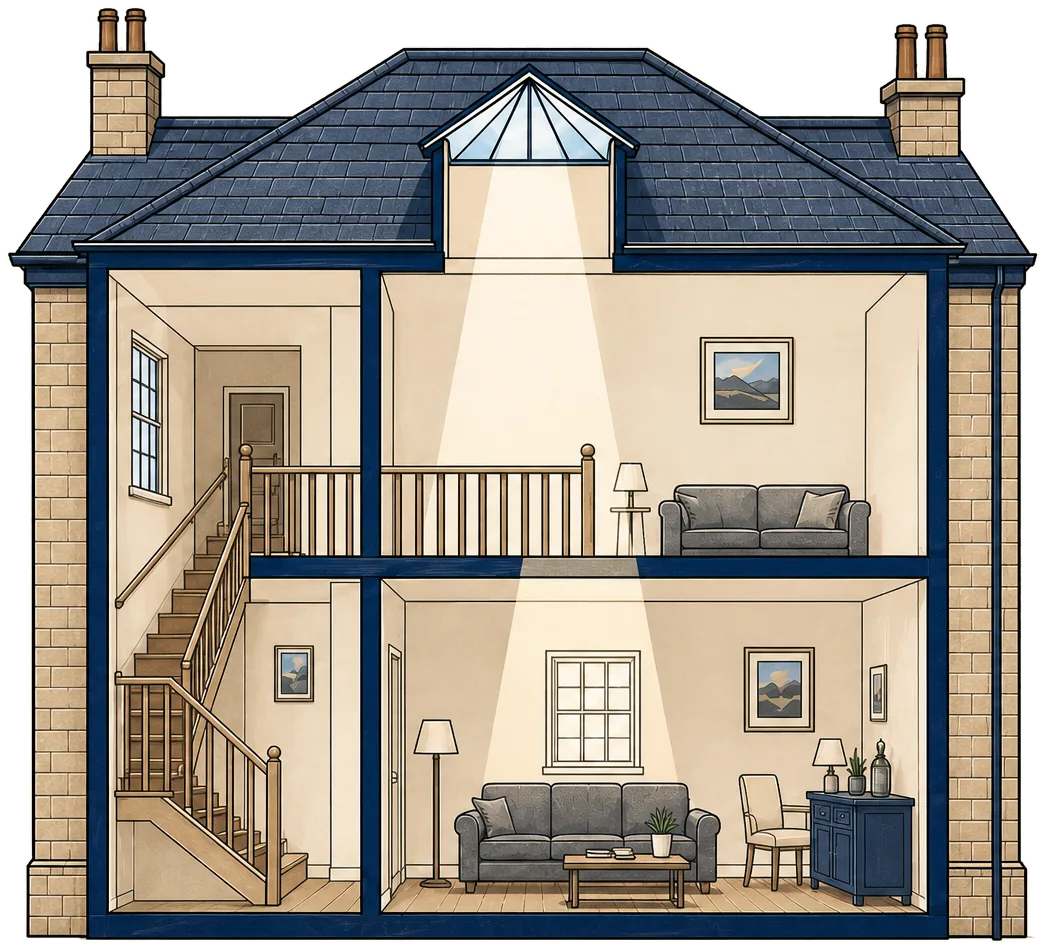
Darfield rooms where the window is small or missing
Older houses in the village have modest windows, and later alterations have added rooms that the walls never planned for.
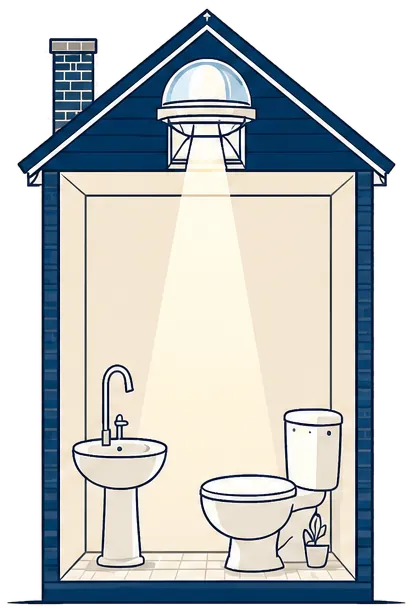 Cottage bathroomA bathroom squeezed under the eaves of an older house has a small window, if any.
 Back-bedroom officeA back bedroom used as an office needs steady daylight on the desk all day.
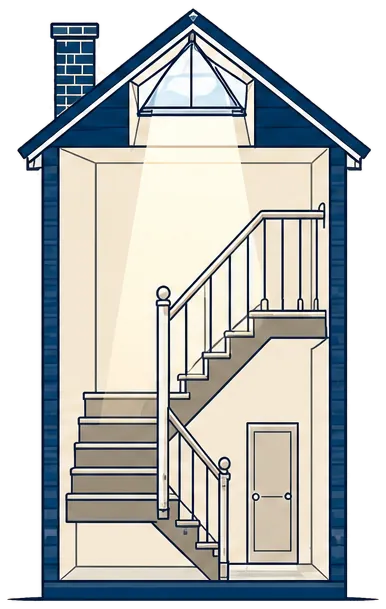 Entrance hallA hall with doors on three sides and the stair above has no window of its own.
Rooflights that suit Darfield's older houses and newer estates
The room is chosen first, then the opening type, then the flashing for the roof covering.
-
 Electric & Opening Rooflights
An electric opening rooflight clears bathroom steam at the press of a switch, and many models add a rain-triggered shut-off.
Electric & Opening Rooflights
An electric opening rooflight clears bathroom steam at the press of a switch, and many models add a rain-triggered shut-off.
-
 Roof Windows
A roof window above a back-bedroom desk gives steady light, and a top-hung frame leaves the head clear when it opens.
Roof Windows
A roof window above a back-bedroom desk gives steady light, and a top-hung frame leaves the head clear when it opens.
-
 Sun Tunnels
A sun tunnel puts a pool of daylight into a hall or landing that the stair above has shut off.
Sun Tunnels
A sun tunnel puts a pool of daylight into a hall or landing that the stair above has shut off.
-
 Energy Efficient Rooflights
Solar-control and low-emissivity coatings cut glare and heat gain on a bright slope above a workroom.
Energy Efficient Rooflights
Solar-control and low-emissivity coatings cut glare and heat gain on a bright slope above a workroom.
-
 Misted Rooflight Replacement
A rooflight misted between the panes is replaced as a glazed unit or as a whole, to suit the frame.
Misted Rooflight Replacement
A rooflight misted between the panes is replaced as a glazed unit or as a whole, to suit the frame.
What Darfield owners ask about rooflights in rooms used every day
Each question starts from a room in daily use and the glazing that suits it.
Which rooflight suits a bathroom where steam is the problem?
Bathrooms made out of the corner of an older house, or fitted into the roof space, often have the smallest window in the building. They also produce more steam than any other room, and a small window clears none of it. A rooflight addresses both problems from above, since warm moist air rises towards it.
Opening or fixed
An opening unit lets that air out. A handle or pole works a roof window, while an electric opening rooflight answers to a wall switch or handset, which suits a bathroom where a pole would be in the way beside the bath. Many models carry a sensor and shut themselves if rain lands on the glass. A fixed unit still brings light, and a small extractor fan can deal with the steam.
Condensation on the glass
Any cold surface in a warm wet room will collect moisture. A sealed double- or triple-glazed unit with warm-edge spacers stays warmer on the inside than a single pane, so less condensation forms on it. A low U-value limits the warmth passing out through the glass, which keeps the inner pane from chilling. The frame matters too: a thermally broken frame keeps the cold from the room side.
Where in the bathroom
A unit is positioned to put light on the mirror and the washbasin, and not directly over the shower where it would be wetted constantly. In a room with a sloping ceiling the opening splays down to the plaster, and the light well is lined with a smooth, washable finish.
Getting through the ceiling
A bathroom ceiling in an older house is often lath and plaster, or plasterboard fixed to joists that run across the room. The opening is cut with the floor protected, the edges are tidied, and the light well's lining runs up to the frame in a finish that stands up to wet. Any pipework or cable in the roof space is checked before the cut, so that nothing is damaged on the way through.
Privacy
A rooflight in a pitched roof looks up at the sky. Nobody can see in from the ground, and a blind or frosted glazing handles the rare overlooking from a higher window. In a bathroom that makes it the most private way to add daylight.
Bathroom-glazing words worth knowing
- U-value
- A measure of heat lost through the glass; a lower figure means less lost.
- Warm-edge spacer
- The strip between the panes, made of a material that conducts less heat than aluminium.
- Rain sensor
- A detector that closes an electric rooflight when it feels water on the glass.
- Light well
- The lined shaft between the roof window and the ceiling opening.
Can an old rooflight be replaced without disturbing the ceiling inside?
A rooflight in a house in Darfield may have been fitted years ago, and by now it can be misted, draughty or simply too poor at holding in heat. Replacing it with a fresh unit in the same position is much less work than cutting a fresh opening, and the room below is spared most of the mess.
What comes out and what stays
The old frame is released from the roof, along with the flashing around it. The timber opening stays where it is, since the rafters have already been trimmed round it. A new frame is set into the same gap, with new flashing laid in to suit the covering. Inside, the light well and the plastered reveal usually remain untouched, although the lining at the very top is renewed where the old frame was fixed.
Matching the size
Rooflights are made in standard sizes, and a replacement has to fit the existing opening. If the old unit is a VELUX, a label on the frame carries its size code, with the width in the letter and the height in the digits. A different make can be fitted if its size matches. Where no label survives, we measure the opening and name the unit and its size in the written quote.
Weathering the new frame
The flashing is the part that keeps water out, and it is laid in to suit the covering: a slate kit for a slate roof, a tile kit for a tiled one. Where the old flashing has corroded or lifted, that can explain a stain on the ceiling below. The new set is lapped under the covering above and over the covering below, so water runs round the frame and onto the roof. The tiles or slates beside it are re-laid tight against it.
A chance to improve the glass
Glazing has moved on a long way. A new sealed unit meets the current energy standard: a roof window must reach 1.4 W/m²K, or Window Energy Rating band B, and a rooflight 2.2 W/m²K. An old single-glazed unit will fall short of both, so the room below loses far less heat once it is replaced.
When the whole frame has to go
Sometimes the sealed unit alone cannot be changed, because the frame is rotted or the rooflight is an early design with no spare glass. Then the complete rooflight is replaced, and misted rooflight replacement sets out how that choice is made.
Marks on an old rooflight that help with a match
A size label on the frame, the maker's name on the glass edge, and any rot at the bottom corners of the timber.
Our back bedroom is now an office. Which roof window keeps glare and heat down?
Working from a bedroom has put new demands on rooms that were never planned as offices. A desk needs steady light and no glare on the screen, and the wall window may sit behind the person working. Where the room has the roof above it, a roof window can do what the wall window cannot, supplying even daylight from above.
The slope matters
A slope that faces the afternoon sun delivers strong light and a good deal of heat on a bright day. A slope facing away gives softer light that changes little through the day, which is what most desk work wants. If the only option is a sunny slope, solar-control glazing and an internal or external blind keep it comfortable.
Which way the window opens
Centre-pivot frames swing on a midpoint pivot, which works over a desk or other furniture. Top-hung frames swing out from the upper edge and keep the head clear, which helps where the ceiling slopes low and people stand near the glass. Our roof window page covers both, and you can compare the coatings on energy efficient rooflights.
Blinds and control
A blind fitted to the frame cuts glare and heat when needed and leaves the room bright when it is not. Some blinds are cranked by hand; others run on a motor and are operated from the same remote as an electric opening unit. At the desk, a blind that lowers from the top of the glass shades the screen but leaves the lower part open for light.
Position over the desk
The best place for the unit is usually beside the desk and not directly above the screen, so the light falls across the work and not onto the monitor. A tall person at a standing desk wants the glass above head height. These points are settled on site when the position is marked out against the furniture.
Heat in summer, warmth in winter
The same glass that lets in summer sun also has to hold the heat in once autumn arrives. A unit with a low U-value and a warm-edge spacer does both jobs, and the blind handles the brightest days. Working in the room all year, you notice both ends of that range.
The planning side
A house roof window normally stays within permitted development provided it rises no higher than 150mm above the roof plane and stays under the ridge. The conditions are in our planning guide, and Barnsley Council can confirm a particular address.
- Myth: A skylight in a home office will make the room too hot to work in.
- Fact: Solar-control glazing and a blind limit how much heat comes through, while an opening unit releases warm air.
- Myth: A roof window always gives glare on a screen.
- Fact: Placed to one side of the desk, the glass throws light across the work and not onto the monitor.
Around Darfield and the Dearne valley
We also cover Wombwell, Brampton, Grimethorpe, Cudworth, Hoyland, Worsbrough and Barnsley, along with the villages between. Our workmanship carries a ten-year guarantee, and 0113 436 0654 is the number to ring for a visit.
Darfield householders on bathroom steam and office glare
Who looks after the Building Control side of a rooflight in Darfield?
We handle the Building Control notification, choosing between Barnsley Council and a registered building control approver for the route that suits the work. A new opening is notifiable as structural work and a replacement under the energy rules, and the notification covers both.
Can a rooflight go directly above a shower?
A sealed glazed unit can sit over a shower, but it is more sensible to place it nearer the basin and mirror so the glass is not under constant spray. A fixed unit over a shower still passes light, and the diffuser or the glass is wiped clean like any wet-room surface.
Will one roof window be enough for a long back bedroom?
A single roof window lights a room well when it sits near the middle of the working area, and a long bedroom can take two if the desk and the bed are at opposite ends. Rafter spacing and the slope's length limit where a pair can go.
What happens to the plaster around the opening inside?
Plaster forms the reveal between ceiling and frame, square or splayed as quoted, and the surface is ready for paint. The edges of the ceiling opening are cut back neatly first, so cracks do not run across old plaster.
Get a free survey
- No obligation
- We survey before we price
- WhatsApp or phone, whichever suits
We arrange a survey, then send a fixed written quote. Nothing is booked until you say yes.